Best 3D Resin Printer Enclosure for Odor Control, Dust Protection, and Safe Ventilation
For enthusiasts and small studios, a dedicated resin printer enclosure can improve print quality, reduce odor, and keep your workspace clean. The following selections focus on reliable ventilation, odor filtration, and sturdy construction to fit popular LCD resin printers. Each option is evaluated for size compatibility, filtration capabilities, observation visibility, and safety features to help you choose the right enclosure for your setup.
| Product | Brand | Key Benefit |
|---|---|---|
| Large Resin 3D Printer Enclosure with Ventilation Kit LED Light | YOOPAI | Two-printer capacity, carbon filtration, front observation window |
| Resin 3D Printer Enclosure with Ventilation | YOOPAI | Carbon filtration, easy observation, dustproof full enclosure |
| Large Resin 3D Printer Enclosure with Ventilation Kit LED Light | Skouphy | Double space, odor control, clear front window |
| Resin 3D Printer Enclosure with Ventilation | Makacces | UV protection, fire-resistant fabric, adjustable ventilation |
| VEVOR 3D Printer Enclosure with Ventilation | VEVOR | Constant temperature, broad compatibility, integrated ventilation |
YOOPAI Large Resin Printer Enclosure With Ventilation

This enclosure is designed to hold two resin printers or a printer plus a curing station, reducing odor leakage and keeping your workspace cleaner. It features a carbon filter to mitigate resin odors and an exhaust system with expandable pipes to vent fumes efficiently. A large, front-facing perspective window offers convenient monitoring without opening the enclosure, protecting the room from contaminated air. Internal dimensions measure 30 inches by 19.7 inches by 28.3 inches, so verify printer dimensions before purchasing.
YOOPAI Resin 3D Printer Enclosure With Ventilation

Offering a six-sided fully enclosed structure, this enclosure enhances dust protection and reduces resin splatter exposure. The carbon filtration system helps maintain an odor-free work area, while exhaust capabilities move pollutants away from your workspace. A clear, front-facing window supports real-time observation without compromising containment, making it suitable for long, unattended prints where resin fumes can accumulate.
Skouphy Large Resin Enclosure With Ventilation Kit

With a double-space design, this enclosure can accommodate a resin printer and curing box, helping keep your workstation organized. It includes a robust odor elimination system with an exhaust duct that can pull air through an activated carbon box for extra filtration. The front window is large and highly transparent to provide a clear view of printing progress, while built-in LED lighting improves visibility inside the enclosure. Internal measurements are approximately 33 by 18.9 by 28.7 inches.
Makacces Resin 3D Printer Enclosure With Ventilation
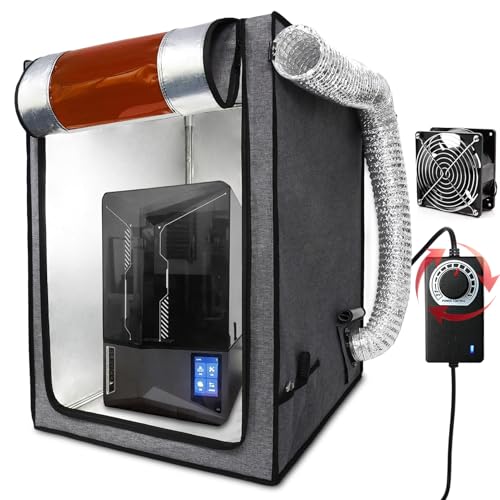
This enclosure emphasizes safety and material longevity with fire-resistant fabric and UV protection to reduce premature resin curing. It includes a 12V fan with a speed controller to tailor airflow, helping to manage fumes while maintaining a stable temperature inside the enclosure. A brown UV-shield window blocks most UV rays, helping preserve resin quality during long prints. It is compatible with a wide range of LCD resin printers and some FDM models.
VEVOR 3D Printer Enclosure With Ventilation
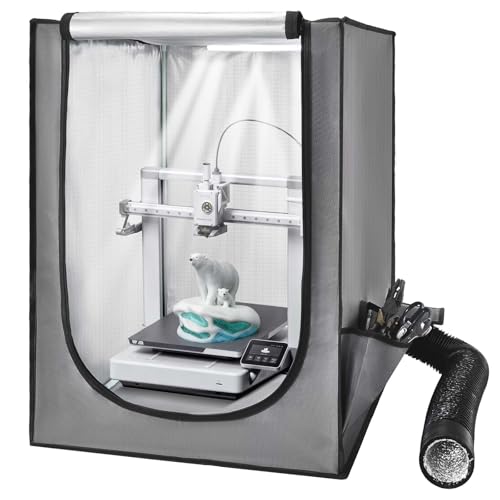
VEVOR’s enclosure provides a stable, constant temperature environment to support resin printing consistency and reduce print failures. The unit is designed to fit most LCD resin printers within its 21.65 x 25.59 x 29.53-inch footprint. It includes a built-in ventilation system to expel fumes quickly, helping to protect indoor air quality. The product is positioned as a versatile option for users expanding beyond a single printer into a small multi-printer setup.
Buying Guide: Key Considerations for Resin Printer Enclosures
- Size and printer compatibility: Measure your printer and curing station to ensure the enclosure interior provides adequate clearance, door clearance, and airflow. Look for models with dimensions that accommodate larger printers or dual-printer configurations if needed.
- Filtration and ventilation: Effective carbon or activated-carbon filtration is essential for odor control. Pair filtration with a venting solution that directs fumes outside or away from your workspace. Consider optional fans and ducting for customizable airflow.
- Observation and monitoring: A clear, front-facing window enables you to monitor resin layers without opening the enclosure, reducing resin exposure and odor release. Some models include LED lighting for better visibility.
- Temperature control: Resin printing can benefit from a controlled environment to improve resin viscosity and print reliability. Enclosures with heater options or better insulation can help maintain consistent temperatures.
- Safety and materials: Look for fire-resistant fabrics or materials, UV protection for resin materials, and robust zippers or closures to maintain a sealed environment during long prints.
- Noise and stability: Enclosures with solid frames and tight seals reduce noise leakage and help maintain a more compact, tidy workspace.
- Ease of assembly and maintenance: Features such as modular panels, simple window access, and straightforward filter replacement can save time and effort during setup and routine upkeep.
- Multi-printer support: If you operate more than one printer, consider enclosures that offer larger internal space or separate sections to minimize cross-contamination and odors.
When selecting a resin printer enclosure, prioritize odor control, reliable ventilation, and the ability to observe prints without compromising containment. For mixed-printer environments, double-space designs or models with robust filtration and optional ducting provide the greatest flexibility. Always verify notebook dimensions against your printer’s footprint and ensure that any added ventilation hardware does not obstruct access to power or resin reservoirs.