Best Anti-Door Kick-in Devices for Added Entryway Security
The best anti-door kick-in device depends on your door and whether you want a portable brace or a screw-mounted lock. The OnGARD brace is suited to buyers seeking a fixed floor-supported barrier for an inward-swinging door. The AceMining reinforcement lock is a compact, drilled-in option, while the Rerishom, SECURITYMAN, and Keplrend bars offer adjustable choices for hinged or sliding doors. Check each device’s fit and installation requirements before buying; these products add resistance but are not a substitute for a complete home-security plan.
| Product | Best for | Type |
|---|---|---|
| OnGARD Security Door Brace | Inward-swinging doors | Floor-supported brace |
| AceMining Door Reinforcement Lock | Compact, installed reinforcement | Screw-mounted lock |
| Rerishom 2-Pack Security Bars | Adjustable door or patio-door use | Two adjustable bars |
| SECURITYMAN 2-in-1 Security Bar | Hinged and sliding doors | Interchangeable-cap bar |
| Keplrend 2-Pack Security Bars | Multiple entry points and floor types | Two adjustable bars |
OnGARD Security Door Brace

The OnGARD is best for someone who wants a floor-supported brace rather than a portable telescoping pole. The manufacturer describes its two-piece design as using the floor and a space-age polymer brace to resist force, and lists a maximum resistance claim of 3,100 pounds. It is designed for inward-swinging doors and can be installed on several floor materials, including wood, concrete, stone, or tile.
Choose this device if you prefer a fixed barrier and can install it at the door. The key limitation is that it is not presented as a fit-for-any-door product: it works with inward-swinging doors, and installation is required. Its force figure is a manufacturer claim, not a guarantee for every door or installation.
AceMining Door Reinforcement Lock

This AceMining lock is best for buyers who want a compact, screw-mounted reinforcement instead of a floor bar. The listing describes an alloy construction, eight included screws in two lengths, and a claimed resistance of up to 800 pounds. It opens by pinching the top and bottom grooves and sliding the lock aside, so it can be engaged or released without repositioning a bar.
It was selected for its permanent, low-profile format and stated force rating. Avoid this option if drilling is not practical or if your door does not match the product’s fit requirements. The listing recommends checking the product images for suitability and using a drill for installation.
Rerishom 2-Pack Security Bars

Rerishom’s two-bar set is best for buyers who want adjustable braces for more than one opening. The bars adjust from 17.5 to 46 inches, with a shorter stated maximum of 43 inches for sliding doors. The listing also specifies a 1.57-inch diameter bar and claims resistance to pressure up to 400 pounds. Its material upgrade is described as intended to improve durability.
Choose this set if its adjustment range suits your door and sliding-door measurement. The two bars can serve different openings, but the listed sliding-door maximum is shorter than the general maximum. Measure each opening before choosing this option, and do not assume the full 46-inch range applies to patio-door use.
SECURITYMAN 2-in-1 Security Bar

The SECURITYMAN bar is best for households that want one device for a hinged door or a sliding glass door or window. Interchangeable caps adapt it to those uses, and the high-grade iron bar adjusts from 18.25 to 47.5 inches. The listing states a 400-pound pressure capacity and describes an angled rubber foot intended to maintain floor contact without scratching surfaces.
Choose it if you value the interchangeable setup and need a bar within its adjustment range. For sliding-door use, the listed maximum drops to 46.5 inches when the sliding caps are installed. Confirm the measurement and cap configuration before relying on it for a particular opening.
Keplrend 2-Pack Security Bars
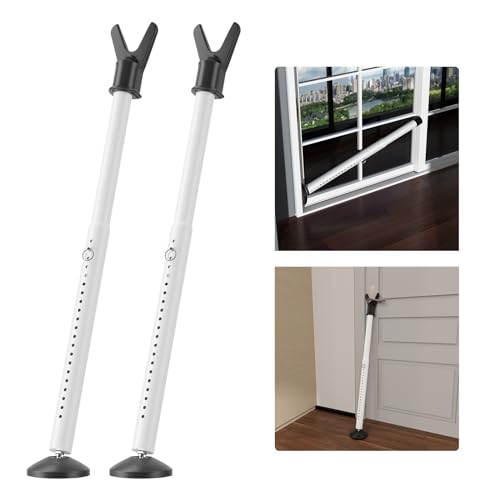
Keplrend’s two-pack is best for buyers who need adjustable bars for hinged doors and sliding doors or windows. The listing gives an 18-to-51-inch adjustment range, a heavy-duty metal tube, and a 3-inch non-slip rubber base. It also claims 350-plus pounds of impact resistance and describes the base as suitable for surfaces including tile, hardwood, carpet, and concrete.
This option was selected for its broad stated range and larger rubber base. Check the opening dimensions and ensure the foot makes firm contact with the floor. The impact-resistance figure is a product claim; actual performance depends on proper fit and installation position.
Buying Guide: How To Choose An Anti-Door Kick-In Device
Should you choose a bar or a reinforcement lock?
A security bar is generally the more adjustable, repositionable choice, and some listed models can also brace sliding doors or windows. A screw-mounted reinforcement lock stays attached to the door frame and does not need to be set on the floor each time. Choose based on door type, installation preferences, and whether you need to move the device between openings.
How do you check fit and floor contact?
Measure the door or sliding-door opening before ordering. Compare that measurement with the product’s stated range for the specific use; some bars have a shorter maximum length with sliding-door caps. For a floor brace, confirm that the foot sits securely against the floor and the door. AceMining specifically cautions users to avoid a gap between the rubber foot and ground.
What installation trade-offs matter?
Bars may be easier to reposition but depend on correct placement and contact. Screw-mounted locks require drilling and a suitable door and frame. A fixed brace such as OnGARD requires installation and is specified for inward-swinging doors. Consider how quickly household members need to release the device, especially in an emergency.
Are force ratings directly comparable?
Not necessarily. Product listings use different terms, including pressure, impact resistance, and force, and the figures may come from different testing conditions. Treat each number as a manufacturer-stated claim rather than a guarantee. Door construction, frame condition, fit, and installation can affect results.
Frequently Asked Questions
What is an anti-door kick-in device?
It is an added door-security product designed to resist forced entry. Examples include floor-supported braces, adjustable security bars, and screw-mounted reinforcement locks.
Can a security bar work on a sliding patio door?
Some listed bars are designed for both hinged and sliding doors. Check the product’s sliding-door adjustment range and included cap or setup requirements before buying.
Do these devices require drilling?
Not all do. The AceMining reinforcement lock uses screws and requires drilling, while the listed bars are positioned as adjustable braces. Follow the product instructions for the selected device.
Which option is best for renters?
A repositionable security bar may suit renters who want to avoid drilling, provided the bar fits the door and floor setup. A fixed lock may require permission to modify the door or frame.
Will a device rated for 800 pounds guarantee a door cannot be kicked in?
No. A stated force rating is not a guarantee for every door, frame, or installation. Review the product’s fit requirements and treat the device as one part of entryway security.