Best Wooden Children’s Step Stools for Bathroom and Home Use
The best wooden children’s step stool depends on your child’s needs, the surfaces where it will be used, and whether you want one or two steps. The WOOD CITY stool stands out for its multiple non-slip pads and two step levels; Forbena offers a white bamboo option with handles; StrongTek emphasizes textured steps and a high stated weight capacity. Harwaya is a dark-finish choice, while LOHASOK is designed for a broader age range and includes a locking side knob.
| Product | Best For | Notable Feature |
|---|---|---|
| WOOD CITY Wooden Step Stool | Wet-area footing | Non-slip pads on base and steps |
| Forbena Wood Toddler Step Stool | Light-colored rooms | Bamboo construction and handles |
| StrongTek Wooden 2 Step Stool | Higher stated capacity | Textured, wide steps |
| Harwaya Wooden Toddler Step Stool | Dark-wood interiors | Two-step design and carrying handles |
| LOHASOK Toddler Kids Step Stool | Multiple ages | Locking side knob and triangular support frame |
WOOD CITY Height-Adjustable Wooden Step Stool

This is a strong choice for families prioritizing grip in a bathroom or kitchen. The stool has two step levels and, according to the product details, 10 non-slip pads: four on the base and six on the stepping surfaces. That combination is intended to reduce sliding both on the floor and under a child’s feet.
Best for: Toddlers who need help reaching sinks or toilets, especially in rooms where floors may become wet. The listed age range is 18 months and up, and the stated weight capacity is 200 pounds.
Consider: The provided details do not specify the stool’s dimensions or explain how its height-adjustable feature works. Check the product information to confirm that its size and setup suit your space.
Forbena White Bamboo Toddler Step Stool

Forbena is a two-step option for buyers who want a light-colored stool that can move between rooms. Its listed features include bamboo construction, child-sized carrying handles, and four soft non-slip mats. The product description gives a stated weight capacity of 250 pounds.
Best for: Families seeking a white finish for a bathroom, nursery, or bedroom, with a stool that can also be carried to the kitchen. Its two levels can help children reach a sink or toilet, and the product description also mentions uses such as sitting to read.
Consider: The product details describe assembly as straightforward but do not provide measurements. Confirm the height and footprint before choosing it for a specific sink or storage area.
StrongTek Wooden Two-Step Stool

StrongTek is suited to households looking for a wooden two-step stool with textured footing and a high stated weight capacity. Its features include a reinforced wooden frame, wide steps with non-slip treads, and side handles for carrying. The product listing states a capacity of up to 350 pounds.
Best for: Buyers who want a two-step design that can be moved between household tasks and value a larger stated capacity. The textured treads are a key distinction from models whose listed grip features focus mainly on floor pads.
Consider: The provided product details do not list an age range, dimensions, or whether the stool is intended for wet-floor use. Supervise children and check those details for your intended setting.
Harwaya Walnut Brown Toddler Step Stool

Harwaya offers a dark walnut-brown finish and a two-step layout for common toddler routines. Listed uses include potty training, reaching a bathroom sink, and helping children reach counters. The stool has carrying handles and four soft rubber feet, and its stated weight capacity is up to 200 pounds.
Best for: Families who want a darker wood look and a portable step stool for more than one room. The handles may make it easier for a child or adult to reposition the stool.
Consider: The listing describes the feet as slip-resistant, but that feature alone does not guarantee stability on every surface. Place the stool on a level floor and supervise climbing.
LOHASOK Wooden Toddler Step Stool
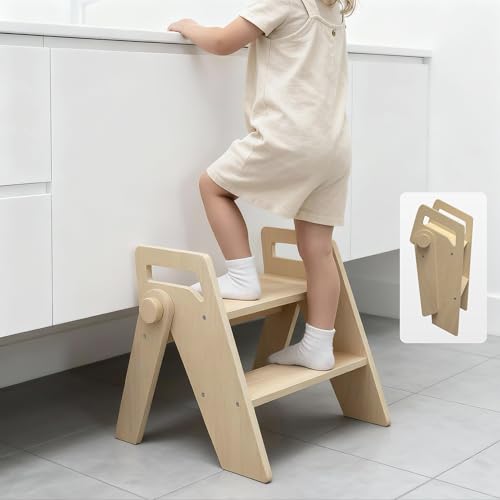
LOHASOK is designed for children from 18 months to 8 years, according to its product details. The listed construction features include a triangular support frame, four non-slip base pads, embedded wooden steps, side handles, and a locking side knob. It has a stated capacity of 300 pounds.
Best for: Buyers who want a stool described for a wide child age range and who value a locking feature as part of the setup. Its side handles and base pads are also useful features to compare with simpler step stools.
Consider: The supplied details do not include dimensions or describe the adjustment process. Verify the assembled size and follow the included setup instructions before use.
Buying Guide: How to Choose a Wooden Step Stool
Should you choose one step or two?
A two-step stool provides more than one climbing level and may help a child reach a sink or counter gradually. A single-step model may suit a smaller boost, but the products in this comparison are primarily two-step designs. Match the stool’s height to the task rather than assuming that more steps are always better.
What safety features should you compare?
Look for clearly described grip features, such as textured step treads, non-slip pads on the standing surfaces, or rubber feet on the base. These features serve different purposes: step treads help feet grip the platform, while base pads are intended to reduce movement on the floor. Use the stool on a level surface and supervise children.
Does weight capacity matter for a child’s stool?
Compare the manufacturer’s stated capacity if adults may also use the stool or if you want to assess its listed support limit. Capacities vary among these options, from 200 to 350 pounds. A higher stated capacity does not replace safe placement, correct assembly, or age-appropriate supervision.
Which material and finish fit your home?
Wood and bamboo stools can differ in appearance and construction. Consider whether you prefer a natural, white, or dark finish and whether the product details identify wood or bamboo. Also check the dimensions, assembly instructions, and care guidance; these details can affect fit and everyday use.
Frequently Asked Questions
Are wooden step stools suitable for potty training?
Many children’s two-step stools are described for potty training and bathroom routines. Choose a design with appropriate height and grip features, and supervise the child while climbing.
Can a toddler step stool be used at a kitchen sink?
Several models in this comparison are listed for kitchen-counter or sink use. Confirm that the stool’s height works for the specific counter and place it on a level floor.
Are non-slip pads and textured steps the same thing?
No. Base pads are intended to help limit movement of the stool on the floor. Textured step surfaces are intended to improve grip underfoot. Some stools include one type, while others list both.
What age should a child start using a step stool?
Age guidance varies by product. One stool here lists use from 18 months, while another describes an age range of 18 months to 8 years. Follow the individual product instructions and supervise use.
Can adults use children’s wooden step stools?
Some listings state weight capacities that include adult-weight loads, but capacity alone does not establish suitability for every adult task. Check the product’s instructions, construction details, and intended use before an adult stands on it.