Best Commercial RO Water Systems for Restaurants and Small Businesses
The best commercial RO water system depends on daily water demand, available pressure, and whether you need on-demand flow or stored water. The iSpring CRO1000 is suited to many small businesses, the CRO2000 targets higher-volume use, and the RCS5T offers a boosted 500 GPD option for light commercial settings. Compare stated output and system design before choosing; rated capacity alone does not establish the flow you will get at your site.
| System | Stated capacity | Best suited for |
|---|---|---|
| iSpring CRO1000 | 1,000 GPD | Small businesses needing tankless supply |
| iSpring RCB3P | 300 GPD | Light commercial use with lower demand |
| iSpring RCS5T | 500 GPD membrane | Light commercial locations with low pressure |
| iSpring CRO2000 | 2,000 GPD | Higher-volume use and low-pressure conditions |
| Oceanic Commercial RO | 800 GPD | Businesses wanting a storage tank |
iSpring CRO1000 Tankless Commercial RO System

Best for: Restaurants, small businesses, and other sites that need a commercial-grade tankless system with a stated capacity of 1,000 gallons per day. It delivers a listed flow rate of 0.7 gallons per minute and has inlet and outlet pressure gauges to help monitor operation.
The four-stage setup uses a sediment filter, two carbon block filters, and a 1,000 GPD reverse osmosis membrane. The product states that the system can remove up to 99% of more than 1,000 contaminants. Choose this model if on-demand water and visible pressure monitoring matter.
Limitation: The recommended booster pump is optional, and the product specifies a working pressure range of 80–130 psi. Check site pressure and pump requirements before purchase.
iSpring RCB3P 300 GPD RO System

Best for: Light commercial users with moderate daily demand who want an under-sink system. Its listed production capacity is up to 300 gallons per day, and the product describes a 1.5:1 pure-to-drain ratio.
The RCB3P uses a freestanding stainless steel frame and metal hanging bracket, features intended to support installation and filter changes. Its membrane is listed as filtering particles as small as 0.0001 microns, and the product says it reduces up to 99% of more than 1,000 contaminants, including lead, chlorine, and PFAS. It may be a better fit than a higher-output commercial unit when demand is lower.
Limitation: At 300 GPD, it has less stated capacity than the other commercial-oriented options here. Confirm that the rated output suits your busiest operating periods.
iSpring RCS5T 500 GPD Commercial RO System
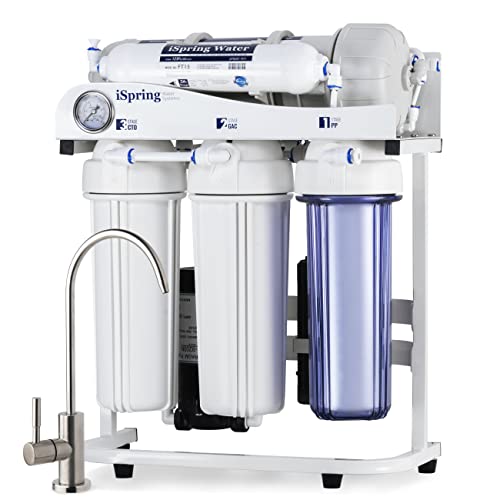
Best for: Light commercial sites such as restaurants, salons, labs, and offices that want a built-in booster pump and a 500 GPD membrane. Its five filtration stages address sediment, rust, sand, chlorine, disinfection byproducts, odor, heavy metals, and pesticide residues, according to the product description.
The system lists a 1.5:1 pure-to-drain ratio. Its booster pump is designed to raise water pressure and support RO production, making this a practical option to compare when supply pressure is a concern. Choose it if you need more stated capacity than the RCB3P but do not need the CRO1000’s listed output.
Limitation: The 500 GPD figure describes membrane capacity; actual site output can depend on operating conditions. Verify requirements for your installation.
iSpring CRO2000 High-Output Commercial RO
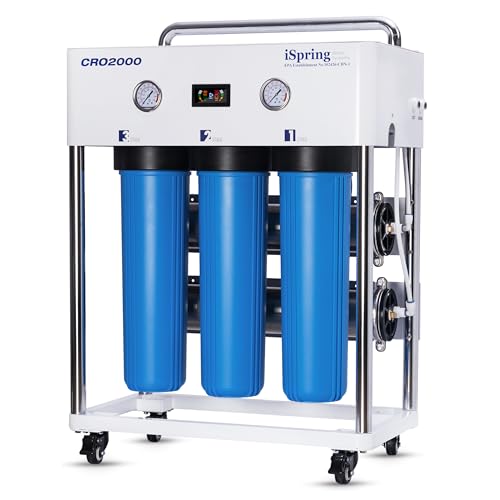
Best for: Businesses with higher water demand that need a stated capacity of up to 2,000 GPD. The tankless four-stage system includes dual booster pumps, two pressure gauges, and a listed output of up to 1.4 gallons per minute.
The product says its membrane reduces up to 99% of more than 1,000 contaminants, including PFAS and lead, and lists a 2:1 pure-to-waste ratio. Dual pumps are intended to address water pressure below 45 psi. Pressure gauges and low-pressure and pump-overload protections support system monitoring. This is the highest-output choice in this comparison.
Limitation: Its stated capacity may exceed the needs of smaller operations. Match output to real demand and check the installation requirements before selecting a high-capacity system.
Oceanic 800 GPD Commercial RO System

Best for: Commercial users who want an 800 GPD system with a booster pump and a 20-gallon tank. The tank distinguishes it from the tankless iSpring models and provides a storage-based configuration to consider for changing usage patterns.
The product describes high-capacity RO membranes and a 1:1 wastewater ratio. It also states that the system removes up to 99% of more than 1,000 contaminants and hardness, including lead, chlorine, fluoride, and arsenic. Choose this model if a tank is part of your preferred setup and its stated capacity fits your needs.
Limitation: The included tank takes space, so measure the installation area and confirm that a storage-based system suits your workflow.
Buying Guide: How To Choose A Commercial RO System
How much water does your business use?
Estimate both average daily use and peak demand. Compare those figures with each system’s stated GPD capacity, but do not treat the rating as a guaranteed output at every site. Water pressure and operating conditions can affect production. A smaller system may suit a light-use office, while a busy food-service location may need higher capacity or storage.
Should you choose tankless or tank-based RO?
Tankless models produce water on demand and avoid a separate storage tank. A tank-based system, such as the Oceanic option above, stores treated water and requires room for the tank. Consider available space, when water is used, and whether stored supply fits the business’s operating pattern.
Does your water pressure require a booster pump?
Check the system’s pressure guidance against the pressure at the installation point. The CRO1000 lists a working range of 80–130 psi and recommends an optional pump below 80 psi. The CRO2000 includes dual pumps and is described as addressing pressure below 45 psi. Confirm pump and pressure requirements rather than assuming the system will produce its rated capacity at low pressure.
What filtration and water-use details should you compare?
Review the stated filtration stages, target contaminants, membrane capacity, and pure-to-drain ratio. Product descriptions may cite broad reduction claims, but water quality and performance depend on the system and conditions. If a specific contaminant is a priority, verify the relevant product documentation and determine whether additional testing or treatment is needed.
Commercial RO System FAQ
What does GPD mean for a commercial RO system?
GPD means gallons per day. It is a stated production capacity, not a promise that every installation will deliver that amount under all conditions.
Which system in this list has the highest stated capacity?
The iSpring CRO2000 has the highest stated capacity in this comparison, at up to 2,000 gallons per day.
Is a booster pump necessary?
It depends on the system’s pressure requirements and the water pressure at your site. Check the product’s specified working range and pump guidance before installation.
Does a tankless system always provide more water?
No. Tankless describes system design, not capacity by itself. Compare stated output, flow rate, pressure requirements, and whether a tank is included.
How should a business choose between 300 and 1,000 GPD?
Estimate daily and peak demand, then compare it with system capacity and operating conditions. The 300 GPD RCB3P is positioned for light commercial use; the 1,000 GPD CRO1000 has a higher stated capacity.