Best Condensing Tankless Gas Water Heaters for Different Home Sizes
The best condensing tankless gas water heater depends on household hot-water demand, installation location, and the flow rate needed when fixtures run together. The Rheem RTGH is a strong fit for larger indoor installations, while the Rheem Prestige offers a listed 11.0 GPM capacity and built-in recirculation. For smaller flow needs, compare the Ranein 5.1 GPM and ThermoMate 5.28 GPM models. The table below summarizes the five condensing options and their stated advantages.
| Product | Stated flow | Best suited for |
|---|---|---|
| Rheem RTGH | 8.4 GPM | Large indoor households |
| Rheem Prestige | 11.0 GPM | High-demand homes seeking recirculation |
| Ranein Condensing | 5.1 GPM | Moderate demand and adjustable controls |
| ThermoMate | Up to 5.28 GPM | Two-shower use under stated conditions |
| Rheem RTGH-RH11DVLN | 11.0 GPM | Indoor installation with built-in recirculation |
Rheem RTGH 8.4 GPM Condensing Heater
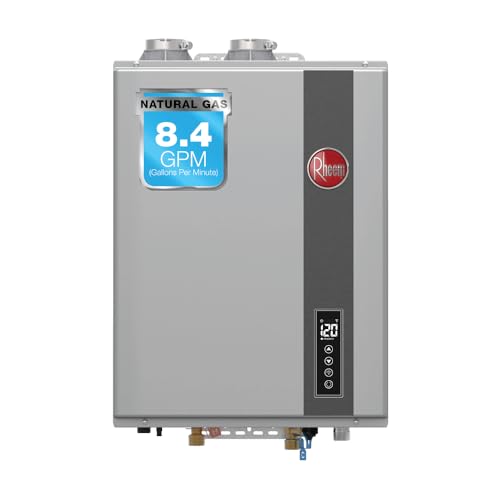
This indoor natural-gas model is best for larger households that need hot water at several fixtures. Its listed output is 8.4 GPM at a 35°F rise, with a 157,000 BTU-per-hour burner. The product details describe it as suitable for three to four simultaneous showers and identify direct-vent indoor installation.
Rheem lists a 0.93 Uniform Energy Factor and condensing technology that captures heat from exhaust. Choose this model if high stated efficiency and whole-house capacity are priorities. A limitation is that its stated flow rate is tied to a 35°F temperature rise, so actual available flow depends on incoming water temperature and the desired output temperature.
Rheem Prestige 11.0 GPM With Recirculation
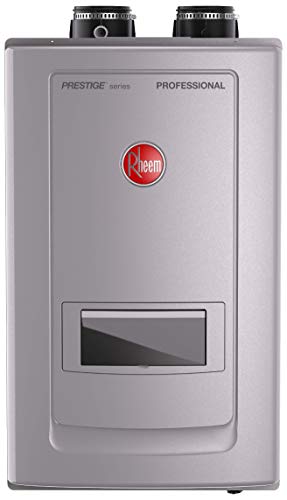
The Rheem Prestige is best for buyers comparing high-flow indoor heaters and built-in recirculation. Its product name lists an 11.0 GPM capacity, and the supplied features highlight hot water with less waiting and water waste, high energy efficiency, and a compact design suited to tank replacement.
Choose this option if recirculation is an important feature in your comparison. The supplied product information does not state its BTU input, detailed venting requirements, or the conditions behind the 11.0 GPM rating. Verify those specifications against the manufacturer’s installation documentation and the home’s demand before choosing it.
Ranein 5.1 GPM Condensing Heater

This Ranein model is best for households with moderate simultaneous hot-water needs and buyers who want on-unit controls. It is listed at 5.1 GPM and 120,000 BTU. The features say it can supply two showers and a kitchen faucet at once, and its condensing design recovers heat from flue gas.
The LED touchscreen offers a 95°F to 149°F setting range, four operating modes, and displays for water flow, gas consumption, and fault codes. Choose it if those controls are useful to your household. Its stated flow is lower than the 8.4 and 11.0 GPM options, making it a less suitable comparison for homes with greater peak demand.
ThermoMate 5.28 GPM Condensing Heater

The ThermoMate is best for a household seeking a mid-range flow rate and a stated dual heat-exchanger design. Its listed capacity is up to 5.28 GPM, with 114,000 BTU input and a 0.86 UEF. The product details specify two showers at 2 GPM each, delivering 105°F water with a 65°F inlet temperature.
Features include a stainless-steel condensing heat exchanger, a copper heat exchanger, and eight listed safety protections. Automatic frost protection is stated to activate at 41°F. Choose this model if its stated two-shower scenario matches your needs. The example flow depends on the listed inlet and output temperatures, so colder incoming water can affect performance.
Rheem RTGH Indoor Whole-Home Option
This entry repeats the Rheem RTGH because it is the supplied product with the clearest combination of indoor installation, condensing technology, and high stated flow. It is best for buyers who want to compare a documented 8.4 GPM model with the higher-flow Rheem Prestige, whose supplied details are more limited.
The RTGH lists 157,000 BTU per hour, direct venting, and a 0.93 UEF. Its product information describes use for three to four simultaneous showers. Avoid treating the shower count as a guarantee for every home: fixture flow, incoming water temperature, and required temperature rise affect real-world capacity.
Buying Guide: How To Compare Condensing Gas Water Heaters
How much flow does your household need?
Add the flow rates of fixtures likely to operate at the same time, such as showers, sinks, or a dishwasher. Compare that total with the heater’s rated GPM at the relevant temperature rise. A heater’s maximum stated flow is not a fixed output under every water-temperature condition.
What does condensing technology mean?
Condensing models recover some heat from exhaust gases to help heat incoming water. The products listed here state different efficiency figures and estimated savings, so compare each model’s stated UEF and confirm details in its current manufacturer documentation. Do not assume every model uses the same venting or condensate arrangement.
Should you choose indoor installation or recirculation?
Match the unit to the available installation location and its venting requirements. The RTGH is specified for indoor direct-vent installation, while the Prestige product name identifies built-in recirculation. Confirm required gas supply, vent materials, condensate drainage, electrical needs, and local code requirements with qualified professionals before installation.
What should you verify before buying?
- Confirm natural-gas compatibility and that the available gas supply meets the unit’s input requirement.
- Check the flow rating at your expected incoming-water temperature and desired hot-water temperature.
- Review installation instructions, venting, condensate disposal, clearances, and required accessories.
- Compare stated UEF and operating features, but do not rely on savings estimates as a guarantee for your home.
Frequently Asked Questions
Are condensing tankless heaters different from non-condensing models?
Yes. Condensing models are designed to recover heat from exhaust gases. Their installation requirements can differ, so confirm venting and condensate instructions for the specific unit.
Can a 5 GPM heater run two showers?
It may, depending on shower flow rates and incoming-water temperature. The ThermoMate listing describes two showers at 2 GPM each under a specific temperature scenario.
Does a higher GPM rating always mean better performance?
No. Higher rated flow can suit more simultaneous demand, but the rating depends on temperature rise and should be compared with the home’s actual fixture use.
Does the Rheem Prestige include recirculation?
Yes. Its product name identifies built-in recirculation. The supplied features do not provide further operating or installation details.
Should a gas tankless heater be professionally installed?
Installation should be planned against the product instructions and applicable local requirements. Have a qualified professional assess gas supply, venting, drainage, and electrical needs.