Best Direct-Bury Gas Line Options: What to Check Before Buying
The safest choice for a direct-buried gas line is a pipe or tubing product explicitly approved for underground installation under your local code—not simply a flexible gas line described as suitable for gas piping. The products below include flexible CSST options and detectable warning tape, but the supplied product details do not confirm that any of the CSST products are approved for direct burial. The Vruelia 3/4-inch line is best for buyers comparing a stated higher-capacity size; its 1/2-inch lines suit lower-capacity applications. ACE Supply tape is an underground-marking accessory, not a gas pipe.
| Product | Best suited for | Important check |
|---|---|---|
| Vruelia CSST, 3/4 inch, 70 feet | Comparing a longer 3/4-inch CSST run | Underground approval is not stated |
| Vruelia CSST, 1/2 inch, 37 feet | Shorter, lower-capacity applications | Underground approval is not stated |
| Thmxit CSST, 3/4 inch, 100 feet | Comparing a long, jacketed CSST option | Confirm code and burial suitability |
| ACE Supply detectable tape | Marking buried utility routes | Tape does not contain gas |
| Acyoyava CSST, 1/2 inch, 40 feet | Comparing a jacketed 1/2-inch line | Underground approval is not stated |
Vruelia 3/4-Inch CSST, 70 Feet
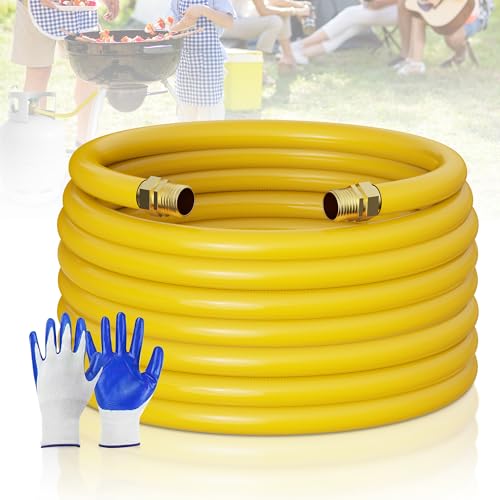
This flexible line is listed as 70 feet long and includes two pre-attached brass NPT male connectors. The product details state that its 3/4-inch size has a 0.875-inch inside diameter and a listed capacity of up to 150,000 BTU. The listing describes cut-to-fit routing and a DIY video guide.
Best for: Buyers comparing a longer 3/4-inch CSST run for an application whose sizing and installation requirements have been professionally verified. It was selected for its stated length, connectors, and capacity information. Caution: The provided details do not establish approval for direct burial. Do not bury it unless the manufacturer and local code specifically allow that installation.
Vruelia 1/2-Inch CSST, 37 Feet

This 37-foot option is the shorter Vruelia 1/2-inch line. Its listing gives a 0.625-inch inside diameter and up to 65,000 BTU capacity, and says the line includes two brass NPT male connectors. The product description also identifies it as cut-to-fit.
Best for: Comparing a shorter, lower-capacity CSST option where the application, fittings, and installation method have been checked. It is a more suitable length comparison than the 70-foot version when less tubing is needed. Caution: The supplied product information does not say it is rated for direct burial, so do not treat its flexibility as proof of underground suitability.
Thmxit 3/4-Inch CSST, 100 Feet

This 100-foot CSST listing describes a SUS304 stainless steel interior, a yellow polyethylene jacket, and brass fittings on both ends. It identifies the tubing as flexible and cuttable, and mentions underground gas piping systems among possible uses. It also advises consulting a professional before cutting the tubing.
Best for: Buyers comparing a long, jacketed 3/4-inch line and seeking clarification from the seller or manufacturer about the exact installation conditions. The stated jacket and length make it relevant to an underground-gas-line search. Caution: A mention of underground use is not enough to establish code approval or direct-burial suitability. Verify the product’s listing, burial instructions, and fitting requirements before purchase or installation.
ACE Supply Detectable Underground Gas Tape

This is detectable marking tape, not a gas-carrying line. The listing specifies a 2-inch-wide, 1,000-foot roll with a 5-mil thickness. It describes permanently imprinted black lettering, laminate construction, and a temperature range from -60°F to 250°F. The stated applications include underground gas and other utility routes.
Best for: Buyers sourcing a utility-identification accessory to help mark a buried gas-line route. It was selected because it directly relates to underground gas work without being confused with pipe. Caution: Tape does not replace approved pipe, required protective measures, utility locating, or applicable local marking rules.
Acyoyava 1/2-Inch CSST, 40 Feet

This 40-foot line is described as SUS304 stainless steel with a yellow PVC jacket and 1/2-inch brass connectors. Its listing says the corrugated tubing can bend and be cut for routing, and reports a 15 PSI high-pressure test. It states compatibility with natural gas and propane systems.
Best for: Comparing a 1/2-inch jacketed CSST line when the required length is between the shorter 37-foot and longer 70-foot options. The listing’s material and connector details support product comparison. Caution: The product details do not establish direct-burial approval. A pressure-test statement alone does not confirm suitability for a particular underground installation.
Buying Guide: How To Choose a Direct-Bury Gas Line
Is flexible CSST automatically suitable for burial?
No. Flexibility, a protective-looking jacket, or a stated gas application does not by itself prove that tubing can be buried directly. Check the exact product documentation for underground approval, installation depth, protection requirements, permitted fittings, and whether it must be placed in a sleeve or conduit. Confirm requirements with your local building department or a qualified gas professional.
How should you compare size and capacity?
Start with the appliance demand, run length, gas type, pressure, and the full system design. The listed Vruelia 1/2-inch products state up to 65,000 BTU, while its 3/4-inch option states up to 150,000 BTU. These figures are product claims, not a substitute for sizing calculations or confirmation that the line is approved for the installation.
What details matter for underground installation?
Look for explicit manufacturer instructions and applicable local-code requirements. Verify the pipe material, burial rating, corrosion protection, joints and fittings, depth, and marking method. Call 811 before digging in the United States to have underground utilities marked. Use a licensed professional where required or when the route, connections, or code requirements are uncertain.
Frequently Asked Questions
Can I directly bury any of these CSST products?
The supplied details do not confirm direct-burial approval for most of these products. Obtain written product documentation and confirm local requirements before using any CSST underground.
Does a yellow jacket mean gas tubing is burial-rated?
No. A jacket description alone does not establish a burial rating. Check the manufacturer’s installation instructions and product approvals.
Is detectable tape a replacement for gas pipe?
No. Detectable tape marks an underground utility route; it does not carry gas or protect a line as a pipe system.
Should I cut CSST to fit a buried run?
Do not cut tubing based only on a general product description. Follow the exact manufacturer’s instructions, use approved fittings, and confirm that cutting and re-termination are permitted for the intended installation.