Best Dual Shower Head Valves for Flexible Shower Setups
A 3-way shower diverter valve is a practical choice for connecting a fixed shower head and a second outlet, such as a handheld shower. The G-Promise model with a holder is best for buyers who want an adjustable handheld mount; the Gicyiit is best for a simple, tool-free installation; and the YDmeet offers a swiveling connector. The options below differ in materials, controls, and flow features, so check connection types and whether you need a shut-off function before choosing.
| Product | Best For | Standout Feature |
|---|---|---|
| G-Promise Diverter With Holder | Handheld shower setups | Pivoting holder |
| Gicyiit 3-Way Diverter | Simple installation | Hand-tightened connections |
| YDmeet Brass Diverter | Adjustable hose positioning | Swiveling outlet |
| G-Promise Chrome Diverter | Basic dual-outlet switching | Solid metal construction |
| Sneatup Brass Diverter | Brass construction | Washer at inlet |
G-Promise Solid Metal Diverter With Holder

This 3-way valve is best for a shower that combines a fixed head with a handheld sprayer. Its metal construction is intended for everyday wear, and the control lets users select either outlet or run both at once. A pivoting handheld holder adjusts forward or backward to help position the spray.
The listed connections are a 1/2-inch IPS inlet and two 1/2-inch NPT outlets. Choose this model if you want a diverter and handheld holder together. Check that your existing fittings match those thread types before ordering; the product listing does not establish compatibility with every installation.
Gicyiit 3-Way Shower Diverter Valve

The Gicyiit is best for buyers adding a second shower outlet without replacing the whole shower system. Its smooth-turn lever switches between two outlets or allows both to run together. The listing says installation uses a rubber washer and hand-tightened connections, with included thread tape available if a connection still leaks.
It can be used with a handheld shower, rain head, shower wand, pet sprayer, or bidet sprayer, subject to matching connections. A key limitation is that this valve does not shut off water completely; it redirects flow. When both outlets run, the water is shared between them.
YDmeet Adjustable Brass Shower Diverter

This YDmeet valve is best for users who want to change the angle of a handheld shower connection. Its outlet swivels, which can help position a hose and reduce awkward routing. The listing describes a solid brass body and a 3-way lever for selecting either outlet or using both simultaneously.
When both outlets are on, the listing says flow is divided and depends on available water pressure. Choose this model if an adjustable outlet is a priority. Avoid assuming that simultaneous use will deliver the same flow from each head as using one outlet alone.
G-Promise Solid Metal 3-Way Valve

This G-Promise diverter is best for a straightforward fixed-head and handheld arrangement. It has a solid metal body, a 1/2-inch IPS female inlet, and two 1/2-inch NPT male outlets. The control directs water to either outlet or sends water through both at once, making it a simple option when a separate holder is not needed.
The important limitation is that this valve has no shut-off position. It redirects water but is not a replacement for a dedicated shut-off control. Confirm the inlet and outlet thread specifications against your shower hardware.
Sneatup Solid Brass 3-Way Diverter
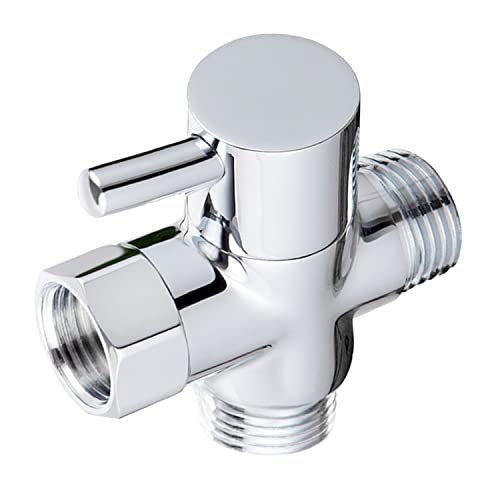
The Sneatup is best for buyers seeking a compact brass diverter with standard G1/2 connections. It has one G1/2 female inlet and two G1/2 male outlets, plus a washer seated in the inlet to help seal the connection. The listed features also describe a chrome-plated surface and solid brass construction.
Choose this model if its connection format matches your shower arm and accessories. The product details describe switching outlets but do not specify a shut-off mode or a holder, so buyers needing either feature should consider another option.
Buying Guide: How To Choose A Dual Shower Head Valve
Do you need a two-way or three-way valve?
A 3-way diverter generally lets you select one outlet or use both outlets together. A two-way valve may only switch between outlets. Check the control description carefully: “dual shower head” does not necessarily mean both heads can run at once.
Which connection type should you check?
Compare the valve’s inlet and outlet thread sizes and types with your shower arm, hose, and shower heads. Listings here include G1/2, IPS, and NPT specifications. Do not assume that similarly sized threads are interchangeable; confirm the fitting requirements for your setup.
Is a shut-off control important?
Most products in this selection redirect water rather than fully stopping it. If you need a pause or shut-off function, verify that it is explicitly listed for the model. The Gicyiit and G-Promise 3-way listings state that their valves do not completely shut off water.
What materials and positioning features matter?
Solid brass or metal construction is a listed feature on several models. For handheld showers, consider whether an included holder or swiveling outlet would help position the spray and hose. A diverter without a holder may require a separate mounting solution.
Frequently Asked Questions
Can a 3-way shower diverter run two shower heads at once?
Some can. The Gicyiit, YDmeet, and G-Promise 3-way models described here list simultaneous use. Flow is shared between outlets when both are running.
Does a shower diverter turn the water off?
Not necessarily. A diverter usually redirects water between outlets. Check the product details for a dedicated shut-off or pause feature.
Can I install a shower diverter without a plumber?
Some listings describe hand-tightened installation, washers, or simple connections. Installation difficulty depends on your existing fittings and setup; follow the product instructions and check for leaks after installation.
Will a dual shower head valve reduce water flow?
Using two outlets at once can divide the available flow. The amount depends on the valve and the water supply. Review the specific product’s flow information rather than assuming both heads will receive full flow.