Best Gas Pipe Leak Detection Solutions for Quick, Safe Inspections
Exploring the best gas pipe leak detectors helps homeowners and professionals identify leaks quickly, reduce safety risks, and protect assets. This guide highlights five top-rated devices that detect methane, propane, natural gas, and other combustible gases, with features like gooseneck probes, audible alarms, and %LEL readouts. Each option balances accuracy, ease of use, and portability for home, RV, or industrial settings. Compare real-world capabilities, battery life, response times, and display clarity to choose the detector that best fits your environment and safety priorities.
| Product | Brand | Key Benefit |
|---|---|---|
| PT199 Natural Gas Leak Detector | TOPTES | Fast 0.5s response with visual and audio alarms |
| PT520A Natural Gas Detector | TOPTES | 17-inch gooseneck for hard-to-reach spots |
| Gasoila Leak Detector Spray | Gasoila | Bubble-based pinpoint testing for all pipe types |
| Klein Tools ET120 | KLEIN TOOLS | Wide range with adjustable sensitivity and strong alerts |
| PT205 Natural Gas Detector | TOPTES | %LEL readout alongside rapid visual/audible alarms |
Buying tip: Look for devices with fast response times, clear audible alarms, and probes long enough to access typical leak zones around pipes, furnaces, and storage areas. Battery life and warm-up time are important for field work, while %LEL readings add depth when evaluating risk. The five selections below emphasize reliability, user-friendly design, and broad gas detection capabilities.
PT199 Natural Gas Leak Detector By TOPTES
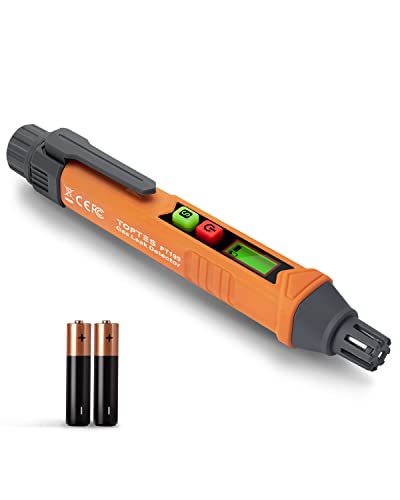
The PT199 identifies common combustible gases such as natural gas, methane, propane, butane, LPG, and more. It provides quick bilingual-style feedback with a visual LCD alarm that turns red at higher concentrations and audible alerts. Battery power comes with two AAA cells and a 30-second warm-up. A low-battery indicator helps manage field use, and automatic power-off prevents wasted energy after periods of inactivity.
PT520A Natural Gas Detector With Gooseneck

Designed for tight spaces, the PT520A uses a 17-inch gooseneck to reach hard-to-access areas such as pipelines or storage areas. It detects methane, propane, natural gas, LPG, butane, and more, with a 50–10,000 ppm range. Visual and audible alarms begin within 0.5 seconds and intensify with concentration. A compact display helps users interpret results in real-time, making it suitable for both indoor and outdoor leak investigations.
Gasoila Leak Detector Spray

Gasoila’s leak detector spray uses fast-acting bubbles to pinpoint tiny leaks across all pipe types. The formula is non-toxic and non-corrosive, safe for gas lines and air systems, and the visible bubbles remain for about 10 minutes to confirm the leak location. It’s ideal for quick checks on joints, fittings, and connections without damaging materials or equipment, though not suitable for oxygen systems.
Klein Tools ET120 Gas Leak Detector

The Klein Tools ET120 offers a wide detection range around 50–10,000 ppm with adjustable sensitivity. Five red LEDs and an 85 dB audible alert provide clear indication as gas concentration rises. Its durability and straightforward interface make it a practical choice for daily inspections, service calls, or educational demonstrations where consistent visibility is key.
PT205 Natural Gas Detector With %LEL Readout

The PT205 adds a %LEL readout, highlighting the lower explosive limit range from 1% to 10% LEL (about 100–5,000 ppm based on methane). It supports a broad gas range including LPG, methane, propane, butane, and more, with a 0.5-second detection time and a graphic bar to visualize risk. Like other TOPTES models, it emphasizes quick alarms and accessible warm-up for portable field use.
Buying Guide: Key Considerations For Gas Leak Detectors
- Gas range and selectivity: Choose detectors that cover methane, propane, natural gas, LPG, and other fuels relevant to your location and hardware. Some models emphasize %LEL readouts for precise risk assessment.
- Response time and alarms: Look for devices with fast detection (0.5 seconds in several models) and clear audible levels (often 75–85 dB) plus visual indicators to ease use in noisy environments.
- Probe length and accessibility: Longer goosenecks (e.g., 17 inches) help reach tight spaces under appliances or behind pipes. Consider bendable probes for irregular layouts.
- Display and readability: LCD readouts, color-coded bars, and red high-contrast alerts improve quick interpretation during inspections in dim areas.
- Power and portability: Battery life, included batteries, and auto-off features affect field usefulness. Some devices require only a few seconds to warm up.
- Durability and safety: For industrial environments, select rugged housings and tools with certified sensors. Non-toxic or non-corrosive testing fluids can decrease collateral risk when using spray testers.
- Application scope: If you work with refrigerants, air systems, or automotive components, ensure the detector is suitable for the specific leak types and temperatures present in those contexts.
- Maintenance and calibration: Some detectors offer data logging, calibration options, and manual adjustment. Regular recalibration helps maintain accuracy over time.
- Price and support: Compare warranties, availability of replacement parts, and customer support quality to protect your investment over the detector’s lifecycle.
- Safety integration: In homes or workplaces, pair detectors with proper ventilation strategies and regular safety checks to form a comprehensive risk mitigation plan.