Best High-Efficiency Reverse Osmosis Systems for Home Water
The best high-efficiency reverse osmosis systems combine strong water production with a lower wastewater ratio. The Waterdrop G3P800 stands out for its listed 3:1 pure-to-drain ratio and 800 GPD capacity; the G3P600 and G2P600 offer 600 GPD tankless designs, while the iSpring RCB3P lists a 1.5:1 ratio and booster pump. Choose based on water demand, available under-sink space, filtration certifications, and the system’s stated efficiency.
| System | Best for | Key efficiency detail |
|---|---|---|
| Waterdrop G3P800 | High household demand | 3:1 pure-to-drain ratio; 800 GPD |
| Waterdrop G3P600 | Fast tankless dispensing | 2:1 drain ratio; 600 GPD |
| Waterdrop G3P600 NSF | Certification-focused buyers | 600 GPD; tankless design |
| iSpring RCB3P | Higher-volume use | 1.5:1 pure-to-drain ratio; 300 GPD |
| iSpring RCC1UP-AK | Buyers wanting UV and remineralization | Booster pump supports RO performance |
Waterdrop G3P800 For High Water Demand
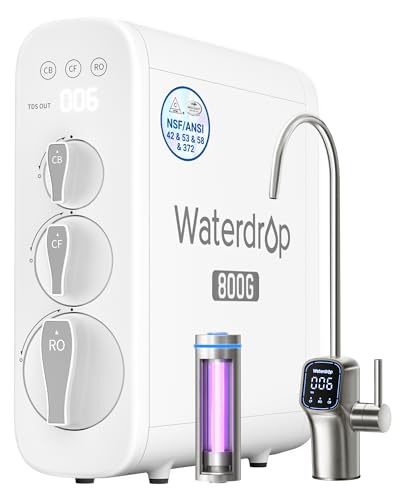
Best for: Larger households that prioritize high daily production and a favorable stated pure-to-drain ratio. The G3P800 has a listed capacity of 800 gallons per day and a 3:1 pure-to-drain ratio, meaning the product information states three cups of filtered water for each cup of wastewater.
Its 10-stage filtration is described as reducing substances including PFAS, fluoride, lead, nitrate, chloride, and radium. The system is certified against NSF/ANSI 42, 53, 58, and 372 for the listed reduction and material claims. It was selected for its combination of high capacity, efficiency information, and specified certifications.
Limitation: Its high stated production capacity may be more than a small household needs. Check under-sink dimensions and installation requirements before choosing a tankless system.
Waterdrop G2P600 For Efficient Tankless Use

Best for: Buyers who want a high-capacity tankless unit with a stated 2:1 drain ratio. The system is rated at 600 GPD, and its product information says it can fill a 200 ml cup in eight seconds. It includes two filters and is certified to NSF/ANSI 372 for lead-free materials.
Choose this model if dispensing speed and reduced wastewater relative to systems without a stated ratio are priorities. Its seven-stage filtration and 600 GPD capacity make it a useful comparison for busy kitchens. It was selected because the listing provides both a production figure and a specific drain ratio.
Limitation: The supplied certification information covers lead-free materials, not the same set of water-reduction claims listed for some other models.
Waterdrop G3P600 For Certified Filtration

Best for: Buyers who want a 600 GPD tankless system and clearly stated certifications for TDS reduction and lead-free materials. The listing identifies NSF/ANSI 58 certification for TDS reduction, NSF/ANSI 372 for lead-free materials, and NSF 42 testing and certification for reducing chlorine, taste, and odor.
The eight-stage filtration system is also described as tested by an independent laboratory for reducing a range of substances. A smart display faucet includes a TDS monitor and filter-life tracker. This model was selected for the combination of tankless design, monitoring features, and listed certification details.
Limitation: The product information provided does not state a pure-to-drain ratio, so buyers comparing wastewater efficiency should confirm that detail before purchasing.
iSpring RCB3P For Higher-Volume Filtration

Best for: Homes or light commercial settings that need a stated 300 GPD capacity and a booster pump. Its listed pure-to-drain ratio is 1.5:1. The system uses a stainless steel frame and metal hanging bracket, and its product information says it reduces up to 99% of more than 1,000 contaminants.
Choose this if a defined wastewater ratio and higher production than a basic low-capacity unit are important. The booster pump and pressure gauge are relevant features for a system designed for residential and light commercial use. It was selected because its efficiency ratio and capacity are both specified.
Limitation: Its 1.5:1 ratio is lower than the 2:1 and 3:1 ratios listed for the Waterdrop tankless options.
iSpring RCC1UP-AK For Pump-Assisted Filtration

Best for: Buyers who want a booster pump alongside UV treatment and alkaline remineralization. This seven-stage system is rated at 100 GPD. Its listed pump pressurizes water through the RO membrane, improving efficiency and reducing wastewater compared with pumpless models, though no specific drain ratio is provided.
The UV filter has a smart flow sensor that activates the light when needed, with a stated three-minute delay. The listing says the system reduces up to 99% of more than 1,000 contaminants. It was selected for shoppers who value pump-assisted performance and extra treatment stages.
Limitation: Its 100 GPD rating is lower than the capacities of the tankless systems above, and the supplied product details do not give a numeric wastewater ratio.
Buying Guide: How To Choose An Efficient RO System
What does a pure-to-drain ratio tell you?
The ratio compares the amount of filtered water produced with the wastewater sent to the drain. A 3:1 ratio means three parts purified water for each part wastewater, while 1.5:1 means one and a half parts purified water per part wastewater. Compare ratios only when the products report them in the same way, and remember that actual performance can depend on installation and operating conditions.
How much daily capacity do you need?
GPD means gallons per day, but it is a rated production figure rather than a guarantee of your household’s real-world output. A 600 or 800 GPD system may suit heavier demand, while a lower-capacity system may be adequate for drinking and cooking. Consider how many people use the water and whether the system will serve other tasks.
Should you choose a tankless system or a booster pump?
Tankless systems can offer a compact design and fast dispensing, but confirm that the unit fits your cabinet and meets installation needs. A booster pump can help pressurize water through the membrane. If water efficiency is the main priority, compare models with an explicitly stated drain ratio rather than assuming that a pump guarantees a particular ratio.
Which certifications should you check?
Read the exact standard and the claim it covers. NSF/ANSI 58 may relate to TDS reduction, while NSF/ANSI 372 addresses lead-free materials. Certification details vary by model, so verify the claims that matter for your water concerns. Filter replacement intervals and costs are also important long-term considerations; confirm them in the product documentation.
Frequently Asked Questions
Which system has the highest listed daily capacity?
The Waterdrop G3P800 has the highest listed capacity among these selections at 800 GPD.
Which listed system has the best pure-to-drain ratio?
The Waterdrop G3P800 lists a 3:1 pure-to-drain ratio, the highest stated ratio in this comparison.
Does a higher GPD rating guarantee less wastewater?
No. GPD describes rated production, while wastewater efficiency is better compared using a stated pure-to-drain ratio.
Do all five systems list a wastewater ratio?
No. The G3P800, G2P600, and RCB3P provide numeric ratios in the supplied information. The G3P600 and RCC1UP-AK do not.
What should I verify before buying?
Check cabinet space, installation requirements, the exact certification claims, replacement-filter details, daily capacity, and the wastewater ratio when one is provided.