Best Hot Tub Heaters Fueled by Fire and Immersion Options
Finding a reliable way to heat a hot tub or bath with fire or immersion methods can expand outdoor soaking seasons. This guide highlights five top options that pair durability, safety, and practical heating performance. Each product below is evaluated on material quality, heat transfer, and ease of use for American homes and outdoor spaces.
Product snapshot
| Product | Brand | Main Benefit |
|---|---|---|
| QUELECO Stainless Steel Heating Coil Heat Exchanger | QUELECO | Wood-fired heat exchange for outdoor baths |
| GANDONE Dual Spa Water Heater | GANDONE | Safe, integrated submersion heater with temperature control |
| XCLBTFDC 1800W Immersion Heater | XCLBTFDC | Precise thermostat with GFCI protection |
| LINGLONGTEMP 1800W Submersible Heater | LINGLONGTEMP | Fast heating with precise control and GFCI |
| Briidea 1500W Titanium Heater | briidea | Corrosion-resistant titanium with reliable thermostat |
QUELECO Stainless Steel Coil Heat Exchanger

The QUELECO heat exchanger is designed for outdoor baths heated by wood fire. Constructed from food-grade 304 stainless steel, the coil offers corrosion resistance and durability for repeated use. The unit’s outer diameter and wall thickness provide a robust heat transfer surface, while its 29-foot length and 3/4″ NPT male connection offer flexible plumbing options. The design enables water to be heated by burning wood without electricity or gas, making it a practical, low-energy option for rustic or off-grid setups.
Key considerations include customization options for dimensions and connectors, which can help tailor the exchanger to existing tubs or fire pits. Maintenance is simplified by stainless steel construction, reducing long-term repair costs. This solution emphasizes reliability and compatibility with outdoor environments where wood-fired heating is preferred.
GANDONE Dual Spa Water Heater

The GANDONE unit is a 1000W immersion heater designed to meet safety limits in typical American households. Its one-piece aluminum casting structure provides safe water separation from the heating element, improving heat distribution and reducing direct contact hazards. A temperature sensor and digital display offer straightforward monitoring of bath temperatures, while a protective coating minimizes mineral buildup. It emphasizes safe operation with grounded electrical setups and prudent power usage for household circuits.
For users seeking controlled heating in a portable spa or tub, this model prioritizes safety, reliable heating, and user-friendly operation. It supports steady temperature management suitable for regular immersion baths and small hot tubs.
XCLBTFDC 1800W Immersion Heater
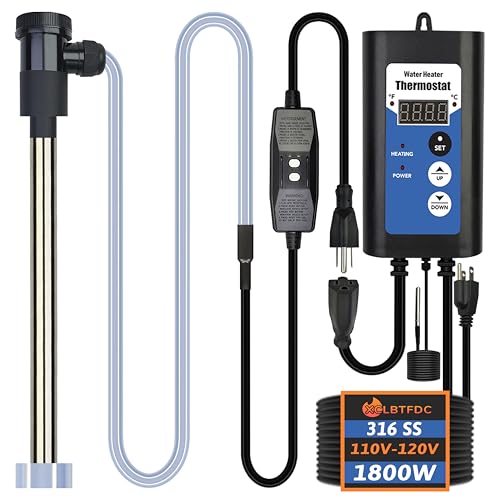
This immersion heater focuses on precise temperature control with a thermostat probe and a long 118-inch cord for distant outlets. The unit uses 316 stainless steel, which resists corrosion and scale buildup. A silicone gasket at the rod bottom helps prevent overheating in inflatable or soft-sided containers, enhancing safety. The product includes a waterproof control panel and a user-friendly setup for tubs, bathtubs, pools, and spas.
With GFCI protection and a focus on rapid, even heating, this option suits configurations where quick warm-up is desired and safety is a priority in water heating applications.
LINGLONGTEMP 1800W Submersible Heater

The LINGLONGTEMP heater offers rapid heating and precise temperature maintenance with a corrosion-resistant 316 stainless steel body. It includes a user-friendly control panel and a sensitive temperature sensor for stable operation within ±0.1°C. GFCI leakage protection adds an essential safety layer, and the rubber-insulated cable reduces the risk of electrical hazards. It is designed for hot tubs, pools, baptistries, and other liquids, making it a versatile option for varied water heating needs.
Briidea 1500W Titanium Heater

The Briidea titanium immersion heater emphasizes corrosion resistance and durability. The device uses a high-grade titanium core with a precise thermostat that maintains the desired water temperature. The unit is designed for fast heating and extended service life, suitable for various liquids including freshwater and mildly corrosive solutions. A corrosion-resistant probe and automatic shutoff help maintain a consistent bath experience without constant supervision.
Buying Guide: Key Purchase Considerations
- Heat source compatibility: Fire-based heat exchangers require durable metal construction and seals that withstand direct contact with flames. Immersion heaters rely on electrical safety features like GFCI protection and waterproof enclosures. Consider which method aligns with your space and safety standards.
- Material quality: Stainless steel, especially 316 or 304 grades, offers corrosion resistance and longevity in wet outdoor environments. Titanium is a premium option for superior corrosion resistance in harsh or saltwater conditions.
- Safety features: Look for GFCI protection, automatic shutoff thermostats, temperature control accuracy (±0.1°C is highly precise), and robust insulation for cords and housings to minimize shock risks.
- Temperature control: Precise thermostats help maintain comfortable soaking temperatures. Decide between digital displays and rotary dials based on user preference and reliability in outdoor conditions.
- Installation and compatibility: Check connector sizes (3/4″ NPT, quick-connects), power requirements (voltage and amperage), and whether the heater is designed for stock tanks, inflatable pools, or fixed tubs.
- Maintenance: Stainless and titanium options resist scale and corrosion. Look for easy cleaning surfaces and minimal mineral buildup to reduce upkeep over seasons of use.
- Portability vs. permanence: Immersion heaters are generally portable and easy to relocate, while fire-based heat exchangers may require more permanent mounting near a fire source or wood stove.
- Safety environment: Outdoor setups should consider splash zones, water containment, and weather exposure. Ensure cords are protected and meet local electrical codes for outdoor use.
- Cost of operation: Wood-fired heat exchangers can reduce energy cost but may require more attention to fire management. Electric immersion heaters have predictable electricity use but require safe electrical wiring and GFCI outlets.
Across these options, readers should weigh heat delivery speed, control accuracy, and safety features against the specifics of their outdoor living space. Each product category—wood-fired heat exchangers and immersion heaters—offers distinct advantages depending on whether the priority is off-grid heating, quick warm-up, or long-term durability in damp environments.