Best Humidity-Controlled Storage Boxes for Cameras, Filament, and More
The best humidity-controlled storage box depends on whether you need active humidity adjustment or a sealed container that works with desiccant. The SLINGER 125L cabinet is best for storing larger collections of camera equipment, while the AUTENS 30L cabinet suits smaller setups. For 3D printer filament, the YOOPAI single-spool box and FUITNERD four-box set provide moisture monitoring and desiccant. The IRIS USA 47-quart bin is a larger passive option for general household storage.
| Product | Best For | Humidity Approach |
|---|---|---|
| SLINGER 125L Dry Cabinet | Large camera and equipment collections | Adjustable electronic control, 30%–60% RH |
| AUTENS 30L Dry Cabinet | Smaller camera setups | Electronic control, 25%–60% RH |
| YOOPAI Filament Storage Box | One 1 kg filament spool | Airtight seal, desiccant, temperature and humidity monitoring |
| FUITNERD Filament Storage Boxes | Several filament spools | Airtight seals, reusable desiccant, hygrometers |
| IRIS USA 47 Qt Storage Bins | General household storage | Gasket seal and locking latches |
SLINGER 125L Electronic Dry Cabinet

The SLINGER cabinet is best for photographers and equipment owners who need a large storage space with adjustable humidity. Its electronic dehumidification system lets users select a relative humidity level from 30% to 60%. A dual LED screen displays temperature and humidity, and the cabinet has five layers for organizing cameras, lenses, and other equipment.
Choose this model if you want active control rather than relying on replaceable or rechargeable desiccant alone. The combination lock adds a security feature. Its main limitation is that its stated adjustment range begins at 30% RH, so it may not suit buyers who need a lower setpoint.
AUTENS 30L Electronic Dry Cabinet

The AUTENS cabinet is best for buyers seeking active humidity management in a smaller storage volume than a 125L cabinet. Its microprocessor monitors temperature and humidity, starts dehumidification when humidity exceeds the selected setting, and stops when the level falls below it. The listed control range is 25% to 60% RH, with stated accuracy of ±1% RH based on laboratory data.
The product description also lists 8W power use and a noiseless design. Consider the stated 30L capacity before choosing it; it may not provide enough room for a large equipment collection. Its electronic controls also mean it needs power, unlike a passive sealed bin.
YOOPAI Single-Spool Filament Storage Box
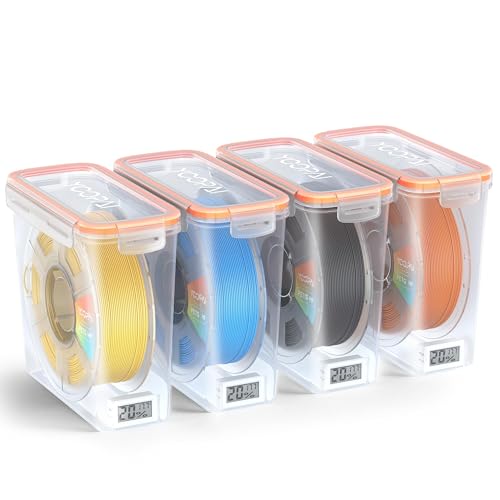
The YOOPAI box is best for makers who want a dedicated container for one standard 1 kg, 1.75 mm filament spool. It is designed for materials including PLA, ABS, PETG, and TPU. The airtight seal, reusable desiccants, and built-in temperature and humidity monitor help users check storage conditions without guessing. Its flat top is designed to support stacking.
Choose this if you want a compact, spool-specific setup with visible readings. The temperature display is in Celsius only. The listed features describe a sealed container with desiccant, not an electronically controlled dehumidifier, so buyers seeking automatic setpoint control should consider a dry cabinet instead.
FUITNERD Four-Box Filament Storage Set
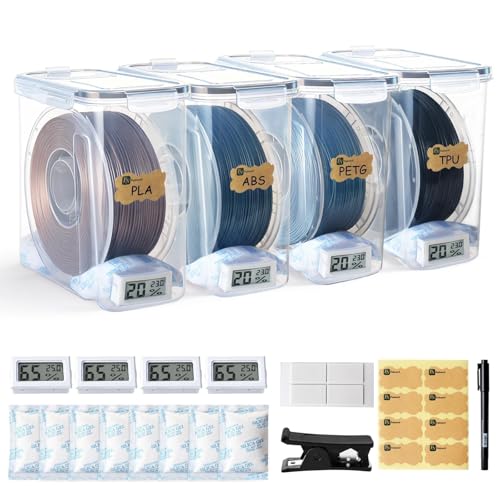
The FUITNERD set is best for 3D-printing users who want separate storage for several spools. Each of the four containers holds one 1 kg spool of PLA, PETG, ABS, or ASA. The set includes four hygrometers, eight reusable color-changing desiccant packs, labels, a marker, and a tube cutter. Each hygrometer can be mounted inside the box, allowing readings without opening it.
This is a practical choice for organizing multiple spools while monitoring each container. Its humidity management depends on the gasket seal and desiccant rather than an electronic controller. Buyers who need to maintain a precise programmed humidity level should look at an active dry cabinet.
IRIS USA 47 Qt Gasket-Seal Bins

The IRIS USA two-pack is best for storing general household items such as documents, clothing, or camping gear when a gasket-sealed bin is more useful than an electronic cabinet. The 47-quart containers have gasket seals intended to help keep out moisture and dust, along with multiple buckle-up latches for a secure lid fit.
Choose these bins for passive storage and larger everyday items. The listed features do not include a humidity display or active humidity adjustment, so they cannot show or automatically regulate the conditions inside. For moisture-sensitive contents, buyers may need to monitor humidity separately and use an appropriate desiccant.
Buying Guide: How to Choose a Humidity-Controlled Storage Box
Do you need active humidity control?
An electronic dry cabinet measures humidity and adjusts its dehumidification around a selected setting. This is the better approach when you want a defined range for camera equipment or other sensitive gear. A sealed bin or filament box is a passive option: its gasket or seal limits exposure, while desiccant absorbs moisture inside. A hygrometer can show conditions, but it does not control them.
How much space and what shape do you need?
Match the storage volume to the items you plan to store. The SLINGER is the largest listed cabinet at 125L, while the AUTENS cabinet is 30L. For filament, the YOOPAI box is designed for one spool, and FUITNERD offers four separate spool containers. The IRIS bins provide 47 quarts each for broader household storage.
What readings or humidity range matter?
Compare the stated control range with the needs of the items you are storing. The SLINGER lists 30%–60% RH, while the AUTENS lists 25%–60% RH. Filament boxes provide monitoring and desiccant rather than a programmable humidity range. Check whether the display units and the number of monitors suit your workflow.
How much maintenance is involved?
Electronic cabinets require a power source and use an active dehumidification system. Passive containers require attention to the desiccant and seal. For reusable desiccant, follow the product’s regeneration instructions, and check hygrometer readings periodically. Do not treat a gasket-sealed container as a guarantee of a specific humidity level.
Frequently Asked Questions
What is the difference between a dry cabinet and a sealed storage box?
A dry cabinet electronically monitors and reduces humidity toward a selected setting. A sealed box limits outside exposure and may use desiccant, but it does not necessarily regulate humidity automatically.
Can a humidity monitor control humidity?
No. A hygrometer measures and displays humidity. It needs a dehumidification system or moisture-absorbing material to change conditions.
Which listed option is made for 3D printer filament?
The YOOPAI box is designed for one 1 kg spool, while the FUITNERD set provides four boxes for separate spools.
Which cabinet offers the lower stated humidity setting?
The AUTENS cabinet lists a range of 25%–60% RH. The SLINGER cabinet lists a range of 30%–60% RH.
Are gasket-seal bins actively humidity controlled?
No. The IRIS USA bins use gasket seals and latches for passive storage. Their listed features do not include active humidity control or a humidity monitor.