Best Kitchen Cabinet Door Profiles and Hardware Options
Kitchen cabinet door profiles describe a door’s shape and surface style, while pulls and handles affect how it looks and opens. Of the products below, the Cinnvoice unfinished pine doors are the direct replacement-door option; the other picks offer different hardware profiles, from edge pulls to a recessed pull. Choose a door based on its dimensions and finish potential, and choose hardware based on its hole spacing, placement, and desired appearance.
| Product | Best For | Profile Or Feature |
|---|---|---|
| Cinnvoice Pine Cabinet Doors | Custom door replacement | Unfinished solid pine |
| Ravinte Finger Edge Pulls | Matte-black hardware | Low-profile edge pull |
| Satanga Edge Finger Pulls | Brushed-nickel hardware | Rounded aluminum edge pull |
| LC LICTOP Finger Pulls | Coordinated drawer hardware | Ergonomic black pull |
| SNOMEL Recessed Pulls | Flush, space-saving pulls | Foldable recessed design |
Cinnvoice Unfinished Pine Cabinet Doors

Best for: A custom cabinet update that starts with replacement doors rather than a new cabinet profile. This set includes two unfinished solid pine doors and four hinges. Each door measures about 16.25 by 22.52 by 0.8 inches, giving buyers specific dimensions to compare with an existing opening or custom setup.
The unfinished surface gives the buyer the option to plan a finish as part of the project. The listing describes the doors as solid wood and says they are designed to resist warping and cracking. This is the most direct choice here for someone searching for a kitchen cabinet door itself, rather than a handle or accessory.
Limitation: The listed size may not fit existing cabinets. Measure the opening and check hinge placement before choosing; the product information does not specify a decorative door profile such as shaker or raised panel.
Ravinte Matte Black Finger Pulls

Best for: Cabinets that need a low-profile matte-black hardware look. The 10-pack offers matching pulls for multiple doors or drawers. Each pull measures 5.9 inches overall, with 5-inch (128 mm) hole centers, so compare that spacing with existing holes before ordering.
These pulls are a practical choice when the cabinet door profile is simple and the hardware should add a dark accent without a large knob. The stated dimensions make this option easier to assess against a project’s layout than a pull listed without hole spacing.
Limitation: The 5-inch hole centers need to match the cabinet’s existing holes, or the installation plan must account for new drilling.
Satanga Brushed Nickel Edge Pulls

Best for: Buyers who want a brushed-nickel edge pull with a rounded, thicker edge. The five-pack is made from aluminum, and the listing describes a polished edge and a larger grip space. Its edge-mounted form can suit a clean, understated hardware profile on cabinet doors or drawers.
The product information says installation uses a powered Phillips-head screwdriver and includes extra screws. Choose this style if you want a finger pull that sits along the cabinet edge rather than a prominent knob. It can provide a different visual profile from a traditional face-mounted handle.
Limitation: The supplied information does not state the hole-center measurement. Check the product’s installation details and cabinet layout before replacing hardware with existing holes.
LC LICTOP Black Ergonomic Finger Pulls
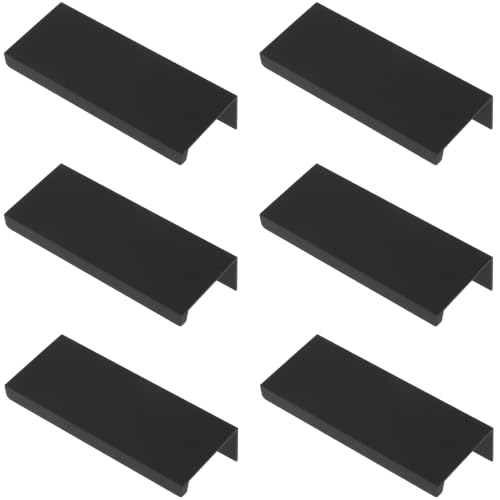
Best for: Buyers who want black pulls with stated hole spacing for a coordinated cabinet or drawer installation. This six-piece set has a 3.15-inch overall length and 2.52-inch center-to-center spacing. Its curved channel is described as guiding fingertips for one-handed opening.
The black finish can coordinate with other dark hardware, and the listing says the smooth electroplated surface is intended to resist fingerprints and smudges. The specified hole spacing is useful when checking whether the pulls will align with predrilled cabinetry.
Limitation: The 2.52-inch hole spacing may not match existing holes for longer handles. Verify measurements before selecting it as a direct replacement.
SNOMEL Square Recessed Flush Pulls

Best for: Buyers who prefer a recessed, space-saving pull rather than hardware that projects from the cabinet face. The two-piece set is made from zinc alloy and measures 4.53 by 1.77 inches. Its foldable pull ring can be returned to the recess after use, and the design hides the screws.
This style is a distinct alternative to edge pulls and conventional knobs. It may be worth considering for a flush appearance on a suitable cabinet, drawer, box cover, or small hatch, as described by the listing.
Limitation: A recessed pull requires an appropriate cutout and installation space. Check the dimensions and mounting requirements before modifying a cabinet door.
Buying Guide: How To Choose A Cabinet Door Profile
Are you replacing the door or changing its appearance?
Start by deciding whether the project requires a new door or only new hardware. The Cinnvoice set supplies unfinished doors with hinges, while the other products are pulls. The listed products do not establish a selection of traditional door-face profiles, such as shaker, slab, or raised-panel designs, so inspect the door’s actual construction and measurements when comparing styles.
Which measurements should you check?
For a replacement door, measure its height, width, and thickness, then compare the hinge arrangement and cabinet opening with the product details. For a handle, measure hole centers from the middle of one screw hole to the middle of the other. Ravinte and LC LICTOP provide hole spacing; the supplied Satanga and SNOMEL details do not.
Which hardware profile fits your kitchen?
- Edge pull: Consider Ravinte, Satanga, or LC LICTOP for a low-profile grip at the cabinet edge.
- Recessed pull: Consider SNOMEL for a pull designed to fold back into its recess, while accounting for the required cutout.
- Finish coordination: Compare matte black and brushed nickel with the cabinet finish and other visible hardware.
Should you reuse existing holes?
Choose a pull with matching hole centers if you want to use existing holes. If the spacing differs, plan for new drilling or another installation approach. For recessed hardware, check cutout dimensions as well as screw placement. Do not assume a handle will fit simply because its overall length looks similar to an existing one.
Frequently Asked Questions
What does “cabinet door profile” mean?
It can refer to the door’s shape, edges, and face design, and is also used to describe the visual style created by its hardware. These products include replacement doors and hardware options, not a full range of door-face designs.
Which product here is an actual cabinet door?
The Cinnvoice product is the direct door option. It includes two unfinished pine doors and four hinges, with listed dimensions of about 16.25 by 22.52 by 0.8 inches.
Which pulls list hole spacing?
Ravinte lists 5-inch (128 mm) hole centers, and LC LICTOP lists 2.52-inch centers. The supplied details for Satanga and SNOMEL do not state hole-center spacing.
Are recessed pulls interchangeable with edge pulls?
No. A recessed pull requires space and a cutout in the door or drawer, while an edge pull attaches along the cabinet edge. Check installation requirements before changing styles.
What should I measure before buying replacement hardware?
Measure hole-center spacing, available edge space, and the handle’s overall dimensions. For a recessed pull, also verify the cutout size and depth requirements.