Best Machines to Seal Plastic Bags for Home and Small Business
The best machine to seal plastic bags depends on bag width, material, and how often you need to seal. For regular packaging, a tabletop impulse sealer offers adjustable heat and a longer sealing bar; the 12-inch Piwerod is suited to varied bag thicknesses, while the 16-inch SEELAUGH handles wider bags. For occasional snack-bag resealing, the portable FEPPO is a compact alternative. The picks below compare these options by their listed features and intended use.
| Product | Best for | Standout feature |
|---|---|---|
| Piwerod 12-Inch Impulse Sealer | Different bag materials and thicknesses | Eight heat settings |
| runruii 12-Inch Impulse Sealer | Household or small-business packaging | Eight temperature settings |
| SEELAUGH 16-Inch Impulse Sealer | Wider bags and trimming excess | Long sealing bar and cutting wires |
| Yeler 8-Inch Impulse Sealer | Narrow bags and compact workspaces | Eight temperature settings |
| FEPPO Mini Bag Sealer | Resealing opened snack bags | Portable sealing and cutting |
Piwerod 12-Inch Impulse Sealer

Best for: Buyers sealing bags made from different materials or with varying thicknesses. This manual impulse sealer has eight adjustable heat levels and a stated maximum sealing thickness of 0.4 mm. It is listed for plastic PE and PP bags, Mylar bags, and kraft paper bags.
The heating element activates when the arm is pressed down, so the unit does not require preheating. An indicator light turns on during sealing and switches off when the cycle is complete. Choose this model if you want a 12-inch bar and more control over heat settings.
Limitation: The stated maximum thickness is 0.4 mm, so it may not suit packaging thicker than that limit. The correct setting depends on the bag material.
runruii 12-Inch Impulse Sealer
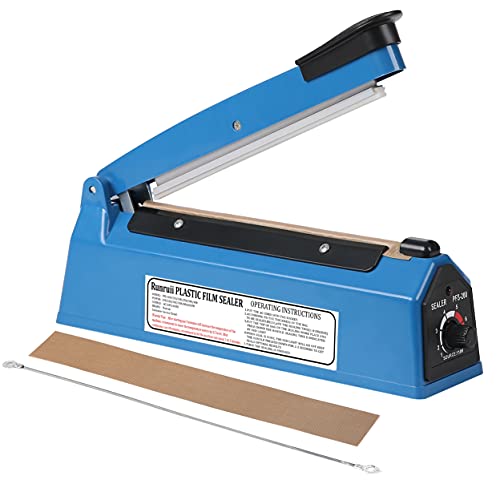
Best for: Household, retail, grocery, and produce packaging where a manual tabletop-style sealer is useful. The runruii has eight temperature settings and is described for PE and PP bags. Its 12-inch sealing length makes it a better fit than a compact hand sealer for wider packages.
Operation is straightforward: place the bag across the sealing area and press the handle for about 2 to 3.5 seconds. The product listing says it needs no warm-up time and includes a built-in fuse. It also comes with an extra replacement element grip.
Limitation: This machine cannot cut bags. Use a separate cutter if you need to trim excess material after sealing.
SEELAUGH 16-Inch Impulse Sealer

Best for: Users who need to seal wider bags or cut away excess plastic. Its maximum hot-seal length is 16 inches, and the listing states a maximum hot-seal thickness of 0.8 mm. Eight adjustable timer levels allow settings to be changed for different bag materials and thicknesses.
The package includes replacement parts: two flat wires for sealing and two round wires for sealing with cutting. The iron shell, built-in fuse, and indicator light are also listed features. Choose this model when the 8- or 12-inch options may not provide enough sealing length.
Limitation: Its 16-inch size requires more work surface than a mini resealer. Check that the bag material and thickness are appropriate for impulse heat sealing.
Yeler 8-Inch Impulse Sealer

Best for: Buyers sealing smaller bags who do not need a long bar. This 8-inch manual sealer has eight temperature settings and is listed for different types of plastic packaging, including PE and PP bags. It activates when the handle is pressed and does not need warm-up time.
The listing describes a built-in fuse, a lightweight design, and an extra replacement element grip. It is intended for household, retail, produce, and grocery use. Choose it over a 12- or 16-inch unit if the bags you seal are narrow and a smaller sealing area is sufficient.
Limitation: The 8-inch sealing length is less suitable for wide bags. The product information does not specify a maximum bag thickness.
FEPPO Mini Bag Sealer With Cutter

Best for: People who want to reseal opened chip and snack bags rather than package products in batches. This compact 2-in-1 device has a sealing head and a separate cutting head. It is portable, includes batteries according to the product name, and has a magnetic strip and lanyard for storage or carrying.
The listing says no preheating is required: turn it on, press, and slowly slide it along the bag. Choose this option for occasional household use when portability matters more than a long, fixed sealing bar.
Limitation: It is a mini handheld resealer, not a 12- or 16-inch tabletop impulse sealer. The listing does not provide a maximum sealing width or material-thickness specification.
Buying Guide: How To Choose A Plastic Bag Sealer
How long should the sealing bar be?
Choose a bar that is at least as wide as the bag opening you need to seal. An 8-inch machine suits narrower bags, while 12-inch models provide more room for larger packages. A 16-inch sealer is the option here for the widest openings. A longer bar does not automatically mean the machine is better; match its size to your packaging and available workspace.
Which bag materials and thicknesses will you seal?
Check the product information for supported materials and thickness limits before buying. Several listed tabletop models mention PE and PP bags, while the Piwerod also lists Mylar and kraft paper bags. The Piwerod specifies a 0.4 mm maximum thickness, and the SEELAUGH lists 0.8 mm. These figures are product specifications, not a guarantee that every bag in that category will seal correctly.
Do you need a cutter?
Some impulse sealers only close a bag; they do not trim the excess. The runruii listing specifically says it cannot cut bags. The SEELAUGH includes round wires for sealing with cutting, while the FEPPO has a dedicated cutting head for its handheld use. If neat trimming matters, confirm that the chosen model includes a cutting function or plan to use a separate tool.
Is a tabletop sealer or a portable resealer better?
A manual tabletop impulse sealer is generally the more suitable format for repeatedly sealing packages along a straight bar. A mini handheld resealer is easier to carry and store, making it practical for reopening and closing snack bags. Compare the intended task, sealing length, and listed material limits rather than treating these formats as interchangeable.
How should heat settings be used?
For an adjustable model, begin with the setting recommended by its instructions and test the bag material before sealing a full batch. Material and thickness affect the heat needed. Follow the product’s directions for how long to press the arm; the listed examples range from about 2 to 3.5 seconds for runruii and 3 to 5 seconds for METRONIC models. Do not assume one setting suits every bag.
Frequently Asked Questions
What is an impulse heat sealer?
An impulse heat sealer applies heat when its sealing arm is pressed down. The listed tabletop models do not need warm-up time, and their heating elements are not described as staying constantly hot.
Can these machines seal any plastic bag?
No. Suitability depends on the bag material, thickness, and the machine’s stated specifications. Check those details and test an appropriate setting before sealing multiple bags.
Can an impulse sealer cut bags?
Some can, but not all. The runruii model cannot cut bags, while the SEELAUGH listing includes wires for sealing with cutting. The FEPPO has a separate cutting head.
Which option is best for resealing opened snacks?
The FEPPO mini sealer is designed for portable snack-bag resealing and combines sealing with cutting. For wider or repeated packaging jobs, compare tabletop impulse sealers instead.
Do manual impulse sealers need preheating?
The tabletop models described here are listed as ready to use without warm-up time. Follow the selected product’s operating instructions and use the heat setting suited to the bag.