Best Mini Freeze Dryer Machines for Home Food Preservation
If you are shopping for a mini freeze dryer machine, first check whether you need true freeze-drying or a countertop food dehydrator. Most products below describe heated-air drying, which removes moisture but is not the same process as freeze-drying. The JNZQMF is best for simple timed drying, the Generic digital model for adjustable controls, and the YDBMY for larger batches. The Cosori is a clearly specified dehydrator option.
| Product | Best suited for | Important note |
|---|---|---|
| JNZQMF 5-Tray Dryer | Small-batch home drying | Timer runs up to 48 hours |
| Generic Digital Dryer | Users wanting a touchscreen | Listed as a dehydrator |
| YDBMY 10-Tray Dryer | Larger drying batches | Large footprint may not suit every counter |
| Cosori 5-Tray Dehydrator | Temperature control and presets | Not a freeze dryer |
| Generic 220V Dryer | Compact snack drying | 220V listing needs careful electrical review |
JNZQMF 5-Tray Food Dryer
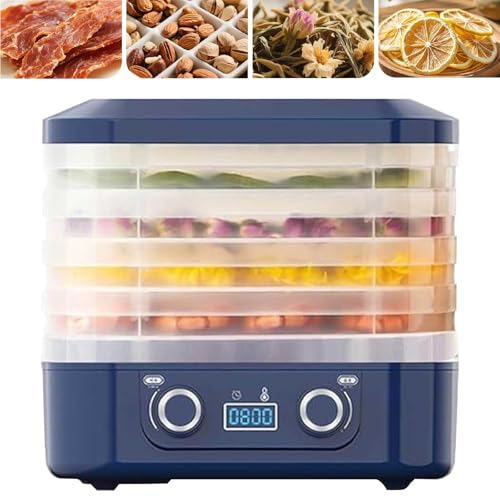
This model is best for home users who want a relatively small appliance for drying fruits, vegetables, meat, and snacks. Its five removable trays support separate batches, and the listing describes dual-knob time and temperature adjustment with an LED display. The timer can be set for up to 48 hours, which offers a longer cycle range than products listed with 24-hour timers.
Choose this if removable trays and straightforward controls matter more than a large tray count. The listing also mentions low-noise operation and easier tray cleanup, but does not provide exact temperature settings or drying capacity. It is described as a freeze dryer, yet the supplied features indicate heated-air dehydration; do not assume it performs true freeze-drying.
Generic Digital Multi-Tray Dryer

This compact home food dryer is best for buyers who prefer touchscreen controls and want the option to expand from four to seven trays. The listing says users can adjust time and temperature digitally and use it for meats, fruits, vegetables, and other ingredients. Its expandable tray configuration can suit meal preparation or making several types of dried food in one cycle.
Choose this model if control interface and potential tray capacity are priorities. The listing does not state the exact temperature range, timer limit, or included tray count, so confirm those details before ordering. It is called a freeze dryer in the product name, but its description presents it as a dehydrator and does not establish true freeze-drying capability. The listed nutrient-retention percentage is a seller claim, not an independently verified result.
YDBMY 10-Tray Food Dryer

The YDBMY is best for households that need more drying area than a five-tray unit provides. Its listing specifies ten stainless-steel trays, each measuring 30 by 28 centimeters, and a timer adjustable from zero to 24 hours. Temperature is listed as adjustable from 30 to 90°C. A rear fan and 360-degree air circulation are described as helping distribute heat through the unit.
Choose this if batch size is more important than a compact counter footprint. The seller lists a capacity of up to 775 grams per tray, but the overall space and electrical requirements should be checked against your kitchen setup. Despite the freeze-dryer wording, the listed hot-air circulation and temperature range describe a food dehydrator, not verified freeze-drying equipment.
Cosori 5-Tray Food Dehydrator
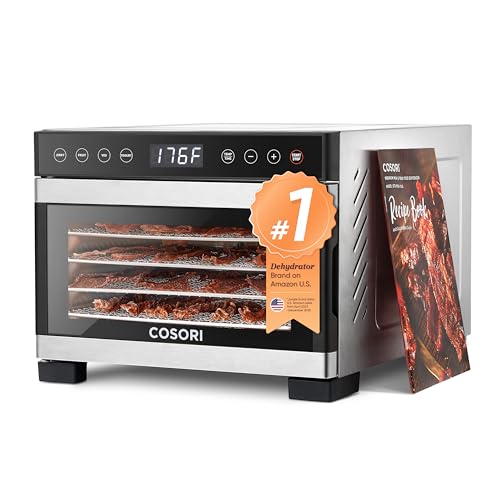
This Cosori is best for shoppers who want clearly stated temperature control and food-specific presets in a five-tray dehydrator. The listed range is 95–176°F, adjustable in one-degree increments. Four presets cover jerky, fruit, vegetables, and yogurt, and the package description includes five trays, a cookbook, a mesh screen, and a fruit-roll sheet.
Choose this if preset programs and a defined temperature range help match the appliance to your recipes. The listing notes USDA guidance of 165°F for safe jerky preparation; follow current food-safety guidance and recipe instructions. This is explicitly a dehydrator, so avoid it if your requirement is a machine that freezes food and dries it under vacuum.
Generic Compact 220V Dryer

This compact countertop dryer is best for buyers interested in drying snacks, herbs, fruit, vegetables, or mushrooms in a small kitchen or food-preparation area. Its listed features include adjustable temperature, a built-in 24-hour timer, and a lightweight design intended for everyday use. The description also mentions candies and jerky.
The key limitation is its stated 220V power requirement. U.S. household outlets are commonly 120V, so verify the appliance’s electrical specifications and your available power before buying; do not assume it can be used with a simple adapter. The listing does not specify tray count or temperature range. Its features describe drying, not confirmed freeze-drying.
Buying Guide: How To Choose A Mini Freeze Dryer
Do you need freeze-drying or dehydration?
True freeze-drying freezes food and removes ice under vacuum. A heated-air dehydrator removes moisture using warm circulating air. They produce different results and are not interchangeable. Check the technical specifications for a vacuum system and freeze-drying process rather than relying on a product title that uses “freeze dryer.”
How much food will you process?
Compare tray count, tray dimensions, and whether trays are removable. Five trays may suit occasional home batches, while ten trays are aimed at larger loads and require more counter space. A stated maximum capacity per tray can help with planning, but it does not guarantee the same drying time for every food.
Which controls matter?
Look for a temperature range and timer that fit the foods you plan to prepare. Digital controls may offer convenient adjustments; knobs may be simpler to operate. A longer timer can be useful for extended dehydration cycles, but actual drying time depends on food thickness, moisture, and preparation.
What should U.S. buyers check before ordering?
Confirm voltage, plug and electrical requirements, dimensions, included trays, and cleaning instructions. This is especially important for listings specifying 220V. Also distinguish seller claims about nutrient retention or performance from details that are directly specified, such as tray count and temperature range.
Frequently Asked Questions
Are countertop food dehydrators the same as freeze dryers?
No. Dehydrators use heat and airflow to remove moisture. True freeze-dryers freeze food and remove ice under vacuum.
Can a mini dehydrator make fruit and jerky?
Several listed models are described for fruit and meat drying. Follow the appliance instructions and appropriate food-safety guidance, especially for meat.
How many trays should I look for?
Choose based on batch size and available counter space. Five trays suit smaller batches; a ten-tray model offers more listed drying area but takes up more room.
Is a 220V appliance suitable for a typical U.S. outlet?
Not necessarily. Check the product’s electrical requirements and your available supply before purchasing; do not assume an adapter makes it compatible.
What is the most important detail to verify?
Confirm whether the appliance is a true vacuum freeze dryer or a heated-air dehydrator, then check voltage, temperature range, timer, and tray capacity.