Best Outdoor Water Leak Detectors for Finding Underground Pipe Leaks
For locating suspected leaks in buried outdoor water lines, acoustic detectors are the most relevant tools in this selection. The PQWT PQ125C is best for users who need sensors for outdoor and indoor scenarios, while the PQ125B focuses on outdoor and industrial detection. Redants suits users who want a digital display and adjustable frequency modes; PQ125A is better suited to indoor sensor work, and Rosvola offers a simpler dual-probe design.
| Detector | Best For | Key Feature |
|---|---|---|
| PQWT PQ125C | Mixed indoor and outdoor use | Three sensor types |
| PQWT PQ125B | Outdoor and industrial lines | General and location modes |
| Redants Underground Detector | Adjustable acoustic searching | LCD and four frequency modes |
| PQWT PQ125A | Indoor pipe leak detection | Two resonance sensors |
| Rosvola Dual-Probe Detector | Basic site investigation | Two probes and rechargeable battery |
PQWT PQ125C Multi-Scenario Leak Detector

The PQWT PQ125C is best for buyers who need one acoustic detector for outdoor pipelines as well as indoor pipe and wall investigations. Its listed sensors include the DMR-H40 for walls and narrow spaces, DMR-V59 for indoor pipelines, and RCS-S3 for outdoor pipelines and industrial water supply pipes.
It has General Mode for scanning a broad area and Location Mode for narrowing down a suspected leak. The manufacturer lists Location Mode accuracy of within 10 centimeters. The model also lists support for 12 languages and two years of worry-free use.
- Choose this if: you want different sensors for several detection environments.
- Limitation: the feature information does not state that the unit is waterproof or suitable for use in rain.
PQWT PQ125B Outdoor Acoustic Detector

The PQWT PQ125B is best for outdoor and industrial leak searches where an operator needs to compare readings across multiple points. Its RC-S3 acoustic chamber resonance sensor and listening rod are described as designed for outdoor and industrial settings and for capturing sound signals conducted through the ground.
General Detection Mode supports a quick scan of a larger area. In Location Mode, the device captures and retains signals from 16 points so the user can compare signal strengths. Its touchscreen includes operational guidance and error pop-ups, which may help users follow the detection process.
- Choose this if: you want a guided interface and point-by-point signal comparison.
- Limitation: accurate interpretation still depends on taking and comparing readings at suitable locations.
Redants Digital Underground Leak Detector
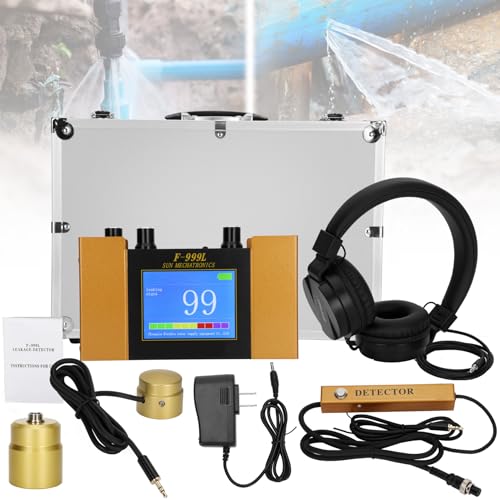
The Redants detector is best for users who want a visible reading alongside acoustic listening. It includes a high-definition LCD, noise-cancelling headphones, and two sensor sizes for different detection environments. Its description says higher displayed values indicate closer proximity to a leak point.
Four selectable frequency response modes are listed for different conditions, including deeply buried metal pipes, shallow-buried PVC pipes, noisy environments, and trace leaks. These features make it a flexible option for users comparing different acoustic settings during a search.
- Choose this if: display readings and frequency selection are priorities.
- Limitation: the listed features do not specify a numerical location accuracy.
PQWT PQ125A Resonance-Sensor Detector
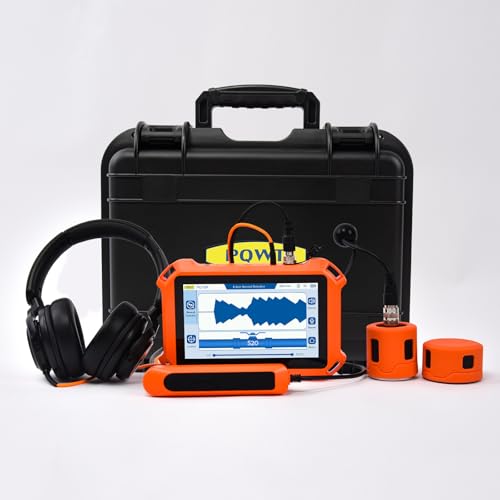
The PQWT PQ125A is best for buyers whose search includes indoor plumbing, rather than outdoor-only use. It uses DMR-H40 and DMR-V59 dual membrane resonance sensors. The product description says these sensors detect changes in resonance amplitude associated with leak sounds that may not be audible to the human ear.
Like the PQ125B, it offers General Mode for scanning and Location Mode for comparing signals from 16 points. A touchscreen provides functional modules, operational guidance, and error pop-ups.
- Choose this if: your work includes indoor pipe environments and you want guided, two-mode detection.
- Limitation: the listed sensors are described for diverse indoor environments, so outdoor specialization is less explicit than on the PQ125B.
Rosvola Dual-Probe Leak Detector

The Rosvola detector is best for users seeking a comparatively straightforward acoustic tool for site investigations. It includes two detection probes for switching according to site conditions and headphones intended to make sound details easier to hear. Its listed applications include water pipes, cement pipes, and steel pipes.
The unit has a built-in rechargeable battery and includes a power adapter. Its description also mentions construction sites and car maintenance, so it is presented for more than household plumbing alone.
- Choose this if: you want two probes and rechargeable operation for varied work sites.
- Limitation: the supplied feature list does not describe a display, scanning modes, or a stated accuracy range.
Buying Guide: How To Choose An Outdoor Water Leak Detector
Do you need an acoustic locator or a water alarm?
These products are primarily acoustic leak-locating tools. They are intended to help detect sounds associated with underground pipe leaks and narrow down a suspected location. A water alarm, by contrast, typically senses water where it contacts the sensor; it does not locate a buried pipe leak. Match the tool to whether you need to find a leak underground or detect water pooling in a room.
Which sensors fit your pipe and work area?
Check the product’s stated sensor applications before choosing. The PQ125B specifically lists an outdoor and industrial sensor, while the PQ125C lists separate sensors for outdoor pipelines, indoor pipelines, and walls or narrow spaces. Redants lists two sensor sizes and frequency modes for different conditions. Do not assume a detector supports a pipe material or depth unless its product information confirms it.
Will you scan broadly or pinpoint a location?
A broad scan helps identify an area worth investigating; a location mode can compare readings at several points to refine the search. The PQWT models describe both types of mode, and the PQ125A and PQ125B list comparisons across 16 points. Redants instead highlights a display reading that rises as the user gets closer to the leak. These methods still require careful placement and interpretation.
What should you check before outdoor use?
Look for clear details about operating conditions, handling, power, and included accessories. The supplied feature information does not establish weather resistance for these detectors, so do not treat them as waterproof. Follow the product manual, use headphones where provided, and consider a plumbing professional when a leak is difficult to isolate or excavation is being considered.
Frequently Asked Questions
Can an outdoor water leak detector locate a buried leak?
Acoustic models can help locate suspected buried leaks by detecting and comparing sounds conducted through the ground or pipe system. Their results depend on the detector, site conditions, and how readings are taken.
Which listed detector is most specifically described for outdoor pipes?
The PQWT PQ125B lists an acoustic chamber resonance sensor and listening rod designed for outdoor and industrial settings. The PQ125C also lists a sensor for outdoor pipelines.
Do these detectors work on every pipe material?
No universal compatibility is established by the supplied details. Rosvola lists water, cement, and steel pipes, while other models describe sensor types or work environments. Verify the intended pipe and conditions before buying.
Are these tools the same as smart leak alarms?
No. These selections focus on acoustic underground leak detection. Smart alarms generally alert users when water reaches a sensor and may not pinpoint a leak inside a buried line.
Can I use one of these detectors in the rain?
The listed features do not confirm rain resistance or waterproof construction. Check the manufacturer’s instructions before exposing a detector to wet weather.