Best Portable Reverse Osmosis Water Filter Systems for Home and Travel
The best portable reverse osmosis water filter depends on how you’ll use it: the Bluevua RO100ROPOT-UV is a strong fit for buyers who want UV treatment and a glass carafe, while the Waterdrop C2SL suits those who want mineralized water and an automatic pitcher. DREO adds TDS and filter-life monitoring, Aigerri emphasizes a large tank and water-saving ratio, and Purewell is designed for battery-powered use away from home. All five options are countertop systems that avoid permanent plumbing installation.
| System | Best For | Standout Feature |
|---|---|---|
| Bluevua RO100ROPOT-UV | UV and mineralization | Six-stage filtration and glass carafe |
| Waterdrop C2SL | Everyday drinking and serving | Mineral filter and autofill glass pitcher |
| DREO Countertop RO | Monitoring and simple upkeep | Live TDS and filter-life indicators |
| Aigerri Countertop RO | Higher-capacity countertop use | 5-liter feed tank and 5:1 pure-to-drain ratio |
| Purewell K8680/P01 | Camping and emergency use | Battery operation and dual UV lamps |
Bluevua RO100ROPOT-UV With Glass Carafe
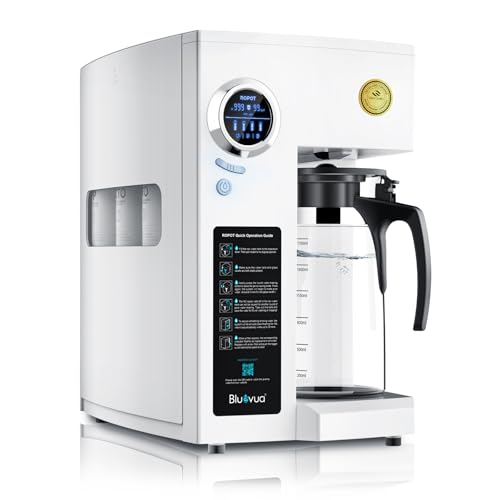
This Bluevua model is best for buyers who want countertop RO filtration with both UV light and mineralization. Its six-stage system includes a 0.0001-micron RO membrane, UV treatment, and a remineralization filter. The product information says it is WQA-certified against NSF/ANSI/CAN 372 for lead-free materials and tested by SGS for contaminant reduction.
The system requires no plumbing, uses a high-borosilicate glass carafe, and is designed to enter power-saving standby mode when idle. Its stated pure-to-drain ratio is 2:1. Choose it if a glass container and mineral addition are priorities. A limitation is that its stated water-saving ratio is lower than the 3:1 and 5:1 figures listed for some alternatives.
Waterdrop C2SL With Mineralized Autofill Pitcher

The Waterdrop C2SL is best for households that want a ready-to-serve pitcher and minerals added after RO filtration. Its seven-stage system uses a 0.0001-micron membrane, and the mineral filter adds calcium, magnesium, potassium, and sodium. The supplied information reports laboratory reductions for PFOA, PFOS, microplastics, lead, chlorine, and fluoride.
There is no plumbing or drilling requirement. Fill the 108-ounce feed tank, plug in the system, and it automatically refills the detachable 40-ounce glass pitcher. This is a practical choice for refrigerator storage and everyday drinks, coffee, or cooking. The pitcher holds less than the feed tank, so frequent serving may mean refilling it between filtration cycles.
DREO Countertop RO With TDS Monitoring
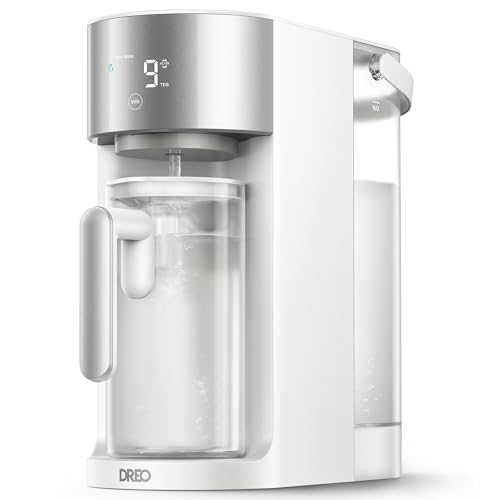
DREO is best for buyers who want visible water-quality and maintenance information. The listed features include real-time TDS readings for raw and purified water, filter-life reminders, an autofill pitcher sensor, and self-cleaning that flushes internal tubes. Its seven-in-one filtration is described as reducing 99.9% of possible contaminants, including PFOA, PFOS, chlorine, and fluoride; the product information says it was tested by SGS to meet NSF/ANSI 58 standards.
The stated pure-to-drain ratio is 3:1, and the unit does not require installation. Choose this model if monitoring and automated pitcher filling are more useful to you than a larger feed tank. The provided details do not specify tank or pitcher capacity, so check those dimensions and volumes before deciding whether it suits your household’s daily demand.
Aigerri Countertop RO With Large Tanks

Aigerri is best for buyers who prioritize water capacity and a high stated pure-to-drain ratio. It has a 5-liter feed tank and a separate 2-liter purified-water tank, with a PPC filter and an RO filter. The manufacturer lists filter performance of up to 529 gallons and a 5:1 pure-to-drain ratio.
This plug-and-play system is intended for kitchens, offices, apartments, and RVs without a permanent water connection. Its larger separate tanks can reduce the need to refill between uses compared with pitcher-focused designs. Choose it if capacity is more important than a glass carafe or detailed live monitoring. The supplied feature list does not identify specific contaminant-reduction test results or certifications, so buyers who require those details should verify them before purchase.
Purewell Portable RO For Off-Grid Use

Purewell is best for campers, RV users, and emergency-preparedness buyers who need filtration that can operate without a fixed countertop power setup. Its K8680/P01 system combines a 0.0001-micron RO membrane with dual UV lamps and a water-quality display. The listing states that it can run for up to 6.5 hours and fill a 2.1-liter bottle in three minutes; it also has a Type-C port that supports reverse charging.
Choose it when battery operation is a central requirement. The listing says filter life can range from 12 to 36 months depending on water quality and use, so replacement timing is not fixed. Its portability does not establish that it is suitable for every untreated water source; follow the manufacturer’s operating guidance and verify source-water requirements.
Buying Guide: How to Choose a Portable RO Filter
Do you need a countertop model or a battery-powered unit?
Most portable RO systems still need an electrical outlet. DREO, Bluevua, Waterdrop, and Aigerri are countertop choices suited to kitchens or other spaces with power access. Purewell’s listed battery runtime and charging features make it the more relevant option for travel or emergency use. Confirm the unit’s power and charging requirements before relying on it away from home.
How much purified water do you need at once?
Compare feed-tank capacity, purified-water capacity, and pitcher size separately. Aigerri lists a 5-liter feed tank and 2-liter clean-water tank; Waterdrop lists a 108-ounce feed tank and 40-ounce pitcher. For the other models, consult the product specifications for capacity rather than assuming the pitcher or reservoir will meet your daily needs.
Which filtration features matter most?
Compare the stated membrane, filtration stages, UV treatment, and mineral addition. A RO system can reduce dissolved substances, but a lower TDS reading alone does not identify every contaminant. Check test reports or certifications for the specific substances you care about, and distinguish independent testing from certification claims.
How should you compare water use and maintenance?
Pure-to-drain ratios offer one way to compare water efficiency: the listed ratios range from 2:1 for Bluevua to 5:1 for Aigerri. Real-world use can vary, so review the manufacturer’s guidance. Filter-life indicators, such as DREO’s reminders and Bluevua’s TDS and filter-status display, can help track upkeep. Confirm replacement-filter availability and the recommended change schedule before buying.
Frequently Asked Questions
Does a portable reverse osmosis system require plumbing?
The countertop systems listed here are described as installation-free. They use a feed tank rather than a permanent plumbing connection, but they still require filling and usually need electrical power.
Does reverse osmosis remove TDS?
RO filtration is designed to reduce total dissolved solids. A TDS display measures dissolved solids broadly; it does not identify which substances are present or prove that water is safe from every contaminant.
Why do some RO systems add minerals?
Some systems include a remineralization stage that adds minerals such as calcium and magnesium after filtration. Buyers may prefer this feature for taste, while others may prefer water without added minerals.
Can a countertop RO filter be used in an RV?
Some listings identify RVs as a possible use, and battery-powered models may suit travel better. Check the unit’s dimensions, power needs, water-source instructions, and operating conditions before using it in an RV.
How often do RO filters need replacement?
Replacement timing depends on the model, water quality, and use. Follow the manufacturer’s schedule and any filter-life indicator; do not assume one model’s stated lifespan applies to another.