Best Recycled Plastic Roof Tiles and Roofing Panels to Compare
If you are searching for recycled plastic roof tiles, note that the products below are plastic or synthetic-resin roofing options, but their listings do not confirm recycled content. The MLYAYE synthetic-resin sheets are best for opaque, all-weather coverage, while WOHNZA and Altovexis polycarbonate panels suit projects where daylight matters. Compare the material, light transmission, panel dimensions, and installation details before choosing.
| Product | Best For | Material Information In Listing |
|---|---|---|
| MLYAYE Corrugated Roof Shingles | Opaque all-weather coverage | Synthetic resin core, ASA surface |
| MLYAYE Bamboo-Shape Resin Tiles | Decorative roofing | ASA and PVC synthetic resin |
| MLYAYE Heavy-Duty Roof Sheets | Larger sheet quantity | Synthetic resin |
| WOHNZA Polycarbonate Panels | Light-transmitting coverage | Polycarbonate |
| Altovexis Clear Panels | Greenhouses and daylighting | Polycarbonate |
MLYAYE Corrugated Roof Shingles

Best for: Buyers who want opaque, lightweight roofing sheets for a shed, garage, or patio. This five-pack is described as having a synthetic resin core and a UV-resistant ASA surface. The listing gives a sheet size of 1.05 by 1.1 meters and says the sheets are designed to resist sun exposure, rain, hail, and freeze-thaw conditions.
The product is selected as a close match for searches about plastic roof tiles because it is a synthetic-resin roofing product, rather than a clear daylighting panel. Its interlocking design and recommended fastening method are described as helping resist wind uplift.
Limitation: The listing does not state that the resin is recycled. Confirm the installation instructions and coverage needed for your roof before ordering.
MLYAYE Bamboo-Shape Resin Tiles
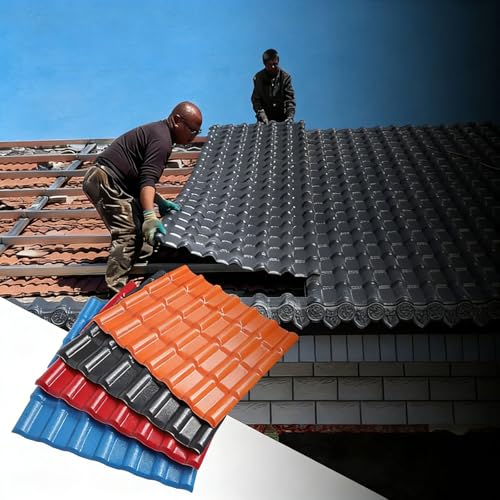
Best for: Buyers comparing decorative, opaque synthetic-resin roofing sheets. This gray option is described as bamboo-shape and is sold in a five-piece set. The listing identifies an ASA surface and synthetic resin core, with stated resistance to UV exposure, rain, hail, and freeze-thaw cycles.
Choose this product if the listed shape and appearance suit a building repair or exterior project. Its stated waterproofing, insulation, and impact-resistance features make it a relevant alternative to clear polycarbonate roofing when daylight through the roof is not the priority.
Limitation: The listing does not verify recycled content or provide a specific recycled-material percentage. Check the actual product dimensions and installation requirements for your roof layout.
MLYAYE Heavy-Duty Resin Roof Sheets

Best for: Buyers who need a ten-piece set of opaque corrugated roofing sheets. The title describes these as 41-inch-wide synthetic-resin roof tiles, while the feature text also lists a sheet size of 1.05 by 1.1 meters. The listing highlights UV resistance, impact resistance, waterproofing, and a lightweight design.
This option is included for people comparing plastic-based roofing by pack size and stated durability features. The manufacturer describes the sheets as suitable for resisting hail and debris and recommends fastening to support wind uplift resistance.
Limitation: The product information does not confirm recycled plastic, and the stated dimensions should be verified with the seller because the title and feature description use different measurements.
WOHNZA Splicable Polycarbonate Panels

Best for: Buyers looking for plastic roof panels that let light through. This ten-piece set is made from 1 mm polycarbonate, which the listing describes as high-transparency, waterproof, cold-resistant, and impact-resistant. It also lists UV protection and use for roofs, awnings, and other protective applications.
Choose this product over opaque resin tiles when preserving daylight is important. Its listed light transmission and corrugated format make it relevant for covered areas where a transparent roof is preferred.
Limitation: The listing does not state recycled content or provide a numerical light-transmission figure. Confirm panel dimensions and the required overlap or sealing method before installation.
Altovexis Clear Polycarbonate Panels

Best for: Greenhouses and other projects that need a clear roof covering. These 1 mm polycarbonate panels are described as 3 feet wide, with corrugations designed to allow panels to splice together. The listing states light transmission of up to 80% and says the material can be cut with scissors to fit a desired shape or size.
This is a better fit than opaque synthetic-resin tiles when plant exposure to sunlight or interior brightness is a priority. The listing also mentions that the panels can be unfolded or rolled up for handling.
Limitation: The listing does not identify recycled material. Cutting and splicing still require careful measurement and appropriate roof sealing to help prevent water entry.
Buying Guide: How To Choose Plastic Roof Tiles
Are these products made from recycled plastic?
The supplied product descriptions do not confirm recycled content for any of these five options. Polycarbonate and synthetic resin are plastic materials, but that does not establish that they are recycled. If recycled content is essential, ask the manufacturer or seller for a documented percentage and material specification before buying.
Should you choose opaque tiles or clear panels?
Choose opaque synthetic-resin sheets when the priority is covering a shed, garage, or patio without transmitting much light. Choose clear polycarbonate panels when daylight is important, such as over a greenhouse or covered work area. The Altovexis listing provides a stated light-transmission figure; the WOHNZA listing describes high transparency without a percentage.
What should you check before ordering?
- Measure roof length and width, then account for overlaps and edges when calculating coverage.
- Confirm the exact sheet dimensions, thickness, and pack quantity with the listing.
- Review installation and fastening guidance for the roof structure and local weather conditions.
- Check whether the product is suitable for your intended use and whether local building requirements apply.
- Ask for written confirmation of recycled content if that is a purchase requirement.
How do synthetic-resin sheets compare with polycarbonate?
In these listings, synthetic-resin options are opaque and describe an ASA surface or resin core, while the polycarbonate options are transparent or high-transparency panels. Compare them based on whether you need daylight, the stated dimensions, and the installation details—not on an assumption that one material is recycled or universally more durable.
Frequently Asked Questions
Are plastic roof tiles the same as recycled plastic roof tiles?
No. A plastic or synthetic-resin product is not necessarily made from recycled material. Look for explicit documentation of recycled content.
Which option is best for a greenhouse?
The Altovexis clear polycarbonate panels are described for greenhouse use and list light transmission of up to 80%. Verify dimensions and installation details for your structure.
Which listed products are opaque?
The three MLYAYE synthetic-resin products are described as gray roofing sheets or tiles. Their listings do not describe them as transparent panels.
Can these products be used on any roof?
The listings describe uses such as sheds, garages, patios, roofs, and awnings, but they do not establish suitability for every roof. Check product instructions, roof structure, and applicable local requirements.
What is the most important detail to confirm before purchase?
Confirm the exact dimensions and installation method, then verify recycled content separately if it is required for the project.