Best Saw Blades for Rough Cut Wood Siding
For rough-cut wood siding, choose a blade intended for framing or ripping wood, and check that its diameter and arbor match your saw. The Hitachi 7-1/4-inch blade is the clearest match for hardboard siding and rough lumber; the FOXBC 24-tooth blade is a compact framing option. For cleaner trim cuts, consider the FOXBC 36-tooth blade. The ZORUNNA blade is a small-format option, while the Malco blade is for vinyl—not wood siding.
| Product | Best suited for | Key distinction |
|---|---|---|
| Hitachi 7-1/4-inch, 24T | Rough lumber and hardboard siding | Full-size framing blade |
| FOXBC 4-1/2-inch, 24T | Compact-saw framing cuts | 3/8-inch arbor |
| FOXBC 4-1/2-inch, 36T | Finer cuts in wood | Higher tooth count |
| ZORUNNA 3-inch, 80T | Small trim or detail work | Very small blade format |
| Malco VCB1 7-1/4-inch | Vinyl siding only | Not specified for wood |
Hitachi 7-1/4-Inch 24-Tooth Framing Blade

Best for: Buyers cutting rough framing lumber, plywood, OSB, softwood, or hardboard siding with a compatible 7-1/4-inch circular saw. Its listed uses make it the strongest direct match for wood siding in this group.
The 24-tooth configuration is intended for framing and ripping, where a fast, practical cut is often more useful than a fine-finish edge. The product has micro-grain tungsten carbide and laser-cut expansion slots described as silicone-filled to reduce vibration and noise. The brand note says Hitachi Power Tools has been renamed Metabo HPT.
Limitation: Confirm the saw’s arbor and blade specifications before installation; the listing specifies a 5/8-inch diamond arbor. A rough-cut blade may leave a less refined edge than a higher-tooth-count blade.
FOXBC 4-1/2-Inch 24-Tooth Framing Blade

Best for: Users with a compatible 4-1/2-inch saw who need a compact framing blade for hardwood, softwood, or plywood. It has 24 teeth and a 3/8-inch arbor, and comes as a three-pack.
FOXBC lists high-density tungsten carbide for toughness and wear resistance. Choose this blade over the 36-tooth FOXBC option when the job is more focused on framing-style cuts than a finer finish. Its smaller diameter may suit a compact saw setup, but does not make it suitable for every circular saw.
Limitation: The listing does not specifically name siding as an application. Check the saw’s manual for permitted blade size, arbor, and operating requirements before use.
FOXBC 4-1/2-Inch 36-Tooth Trim Blade
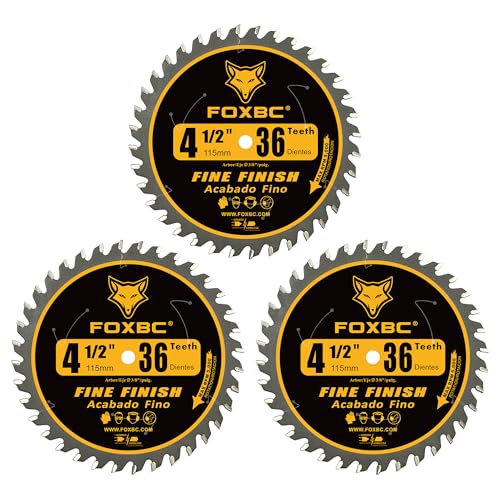
Best for: Buyers seeking a cleaner cut in hardwood, softwood, or plywood with a compatible 4-1/2-inch saw. The 36-tooth count makes it the better FOXBC choice when edge appearance matters more than a rough framing cut.
This three-pack uses high-density tungsten carbide, which the listing describes as tough and wear-resistant. FOXBC names several compatible saw brands, including DeWalt, WORX, Porter Cable, Rockwell, and Genesis. Still, users should verify the exact saw model and arbor rather than relying only on brand names.
Limitation: This is a trim blade, not the most direct match for fast rough cutting. Its 3/8-inch arbor and 4-1/2-inch diameter must match the saw.
ZORUNNA 3-Inch 80-Tooth Saw Blades

Best for: Small-scale trim or detail work where a 3-inch blade is specifically appropriate. The listed materials include hardwood, plywood, OSB, and vinyl siding, and the 80-tooth design is presented for smoother cuts with less splintering.
The set contains six blades and is described as suitable for delicate trim, molding, paneling, and lattice. It may be useful for detail cuts, but its small size and high tooth count are not the straightforward choice for cutting long runs of rough wood siding.
Limitation: The listing mentions operation up to 19,500 RPM. Verify the tool’s blade capacity and maximum speed; do not assume a 3-inch blade fits a standard full-size circular saw.
Malco 7-1/4-Inch Vinyl Siding Blade

Best for: A buyer cutting vinyl siding or fencing with a compatible portable circular saw. Malco describes this blade as providing smooth cuts in vinyl plastics and says it fits portable circular saws.
This option is included as a clear comparison for readers whose siding project may involve vinyl rather than wood. It is not a wood-siding recommendation: the provided product information specifies vinyl plastics, not rough-cut lumber or hardboard.
Limitation: Avoid choosing this blade for rough-cut wood siding unless the manufacturer confirms that use. The listing does not provide tooth count or arbor details, so check fit and application before buying.
Buying Guide: Choosing A Blade For Wood Siding
Should you choose a framing blade or a finer blade?
For rough cuts, a framing blade such as the 24-tooth Hitachi or FOXBC is the more direct fit among these options. A higher tooth count, such as the FOXBC 36-tooth blade, is better suited to cuts where a neater edge is a priority. Match the blade style to the job and the siding material.
What blade size and arbor do you need?
Check the saw manual and the existing blade before purchasing. The products here range from 3 inches to 7-1/4 inches, with listed arbor sizes including 3/8 inch and 5/8-inch diamond. Diameter, arbor shape, saw capacity, and maximum operating speed all need to be appropriate.
Does a vinyl siding blade work on wood?
Do not assume that a blade designed for vinyl is suitable for wood. The Malco VCB1 listing specifies vinyl plastics, while the Hitachi listing explicitly includes hardboard siding and rough lumber. Choose a blade whose listed materials match the siding you are cutting.
What other details should you compare?
Compare tooth count, stated materials, blade diameter, arbor, and pack quantity. Also consider whether the product description identifies the intended task—framing, trim, or vinyl cutting. Do not select based on brand compatibility alone; confirm the exact saw model’s requirements.
Frequently Asked Questions
Which listed blade is the best match for rough wood siding?
The Hitachi 7-1/4-inch 24-tooth blade is the clearest match because its listed uses include hardboard siding, rough framing lumber, plywood, softwood, and OSB.
Is a 24-tooth blade suitable for rough cuts?
It is a framing and ripping configuration in the products listed. It is a reasonable option when the cut does not need a trim-quality finish, provided it matches the saw and material.
Is the FOXBC 36-tooth blade better than the 24-tooth blade?
It is the better choice between those two for a finer cut in the listed wood materials. The 24-tooth blade is more directly positioned for framing cuts.
Can I use the Malco blade on wood siding?
The supplied description specifies smooth cutting in vinyl plastics, not wood. Choose a blade listed for the type of wood siding you are cutting.
Can a 3-inch blade be used in any circular saw?
No. Check the saw’s manual for compatible blade diameter, arbor, and maximum speed before installing a 3-inch blade.