Best Products for Sealing a Block Wall
For sealing a block wall against moisture, Ames Block & Wall Liquid Rubber is the most directly targeted option, with a 5-gallon size for larger projects and a 1-gallon size for smaller ones. Moldable sealant clay is better for individual holes and pipe openings, while expanding foam is suited to filling gaps and cracks. The right choice depends on whether you need a continuous wall coating or a localized repair.
| Product | Best For | Type |
|---|---|---|
| AMES Block & Wall, 5 Gallon | Large wall areas | Liquid rubber coating |
| AMES Block & Wall, 1 Gallon | Smaller coating projects | Liquid rubber coating |
| KEPTFIT Waterproof Sealant Mastic | Small holes and openings | Moldable putty |
| JSWKKGD Moldable Sealant Clay | Irregular gaps and pipe connections | Moldable putty |
| SPRAYMAN Pest Block Spray Foam | Gaps and cracks needing foam fill | Expanding polyurethane foam |
AMES Block & Wall Liquid Rubber, 5 Gallon

This is the strongest match for coating a substantial block wall. The product is formulated for waterproofing concrete walls and cinder block, and its elastomeric liquid-rubber coating can fill cracks and crevices up to ⅛ inch. It can be applied by sprayer, roller, or brush and is also listed for ICF, metal, wood, and other surfaces.
Best for: Homeowners sealing a large concrete or block wall who want a coating applied across the surface, rather than putty for one opening. The 5-gallon format is the larger option in this product selection.
Limitation: Its stated crack-filling capability is up to ⅛ inch; larger cracks or structural issues may need a separate repair before coating.
AMES Block & Wall Liquid Rubber, 1 Gallon
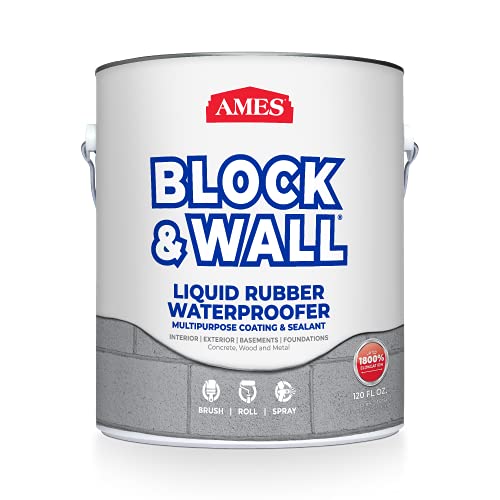
This one-gallon version belongs to the same Block & Wall Liquid Rubber product line and is presented for concrete sealing and waterproofing basements and foundations. Its smaller container makes it a practical choice to consider for a limited wall section or repair area when a larger container is unnecessary.
Best for: Buyers who want the named concrete and foundation waterproofer in a smaller package. Choose it over the 5-gallon option when the project is more limited.
Limitation: The supplied listing information gives the color and weight but not application method, crack capacity, or coverage for this size. Confirm the product label for project-specific directions before use.
KEPTFIT Waterproof Sealant Mastic

KEPTFIT’s moldable sealing clay is designed for filling wall holes and sealing openings such as drain connections and air-conditioning holes. Its soft, flexible material can be shaped by hand, and the listing describes it as waterproof and useful for blocking odors. The product is supplied as a six-pack.
Best for: Small, localized openings through a block wall, especially around a pipe or duct. It is easier to shape around an irregular opening than a liquid coating intended for a broad surface.
Limitation: The listed drying time is two to three days. This is a spot sealant, not a substitute for a continuous waterproof coating over a whole wall.
JSWKKGD Moldable Sealant Clay

This six-pack of sealant clay is intended for wall holes, pipe connections, air-conditioning openings, and household gaps. The product can be kneaded and formed into different shapes, making it useful for uneven or narrow penetrations. Its listing says it fully solidifies in three to five days.
Best for: DIY repairs where a gap has an irregular shape and needs a moldable filler. Choose it when you want small portions that can be shaped around a pipe or wall opening.
Limitation: The instructions say to clean the surface and avoid applying it to damp or wet surfaces. Allow time for the stated solidifying period.
SPRAYMAN Pest Block Spray Foam

This 12-ounce polyurethane foam is designed to expand into gaps and cracks, then harden into a weather-resistant barrier. The listing describes it as suitable for wall openings and concrete cracks, with a precision nozzle for controlled application. It is also described as over-paintable.
Best for: Filling a defined gap or crack where expanding foam is an appropriate repair material. It may suit buyers who need a localized fill rather than a brush- or roller-applied waterproof coating.
Limitation: Because it expands, apply it only where foam filling is appropriate and follow the product directions. It is not a broad-area block-wall coating.
Buying Guide: How To Seal A Block Wall
Do you need a coating or a spot repair?
For a broad masonry surface, consider a product specifically described for waterproofing concrete walls or cinder block, such as the AMES liquid-rubber coating. For a pipe penetration, small hole, or narrow opening, moldable sealant clay can be shaped around the gap. Expanding foam is another localized option when a gap is suited to foam filling.
How large is the project?
Compare the one-gallon and five-gallon AMES options based on the wall area you plan to cover. The supplied product details do not state coverage for the one-gallon size, so check the container label and calculate the amount needed from its directions rather than assuming coverage.
What should you check before applying a sealant?
- Identify where moisture or air is entering and whether the problem is a surface area or an individual opening.
- Check the product’s surface-preparation and application instructions. The JSWKKGD clay listing specifically says to clean the surface and avoid damp or wet application.
- Check the stated limits. AMES 5-gallon coating lists crack filling up to ⅛ inch, while the clay products describe small-hole and gap repairs.
- Allow for the listed drying or solidifying time. The clay products specify several days before fully drying or solidifying.
Frequently Asked Questions
What is the best product for waterproofing an entire block wall?
A coating formulated for concrete walls and cinder block is the best fit among these options. AMES Block & Wall Liquid Rubber is specifically described for that use.
Can sealant clay waterproof a whole block wall?
The listed clay products are intended for holes, pipe connections, and other localized gaps. They are not described as coatings for covering an entire wall.
Can I use moldable putty around a pipe opening?
Yes. The KEPTFIT and JSWKKGD listings both describe use around pipe or drain connections and wall openings. Follow each product’s surface-preparation and drying instructions.
How long does wall-hole sealing clay take to dry?
Drying times vary by product. KEPTFIT lists two to three days, while JSWKKGD says it fully solidifies in three to five days.
Should I use foam or liquid rubber for cracks?
Use liquid rubber when the goal is a coating across a block-wall surface or filling listed cracks up to ⅛ inch. Consider foam for a defined gap suited to expanding foam, following the product directions.