Best Septic Tank Grinder Pumps for Residential Wastewater Systems
The best choice for a septic tank grinder-pump application depends on whether you need an actual cutting pump or a general sewage pump. The AIDPATH and AQUASTRONG models list cutting components; the FOTING options are described as sewage or effluent pumps, not confirmed grinder pumps. Check the manufacturer’s permitted use before installation: some listings explicitly say not to use the pump in a septic tank.
| Product | Best For | Key Consideration |
|---|---|---|
| AIDPATH 1HP Grinder Pump | High-lift applications | Requires a 20A GFCI breaker, according to the listing |
| AQUASTRONG 1HP Grinder Pump | Cutting solids in a basin | Listing warns against certain gas-filled tank environments |
| FOTING 1.5HP Sewage Pump | High flow at modest lift | Not specified as a grinder pump |
| FOTING 1HP 6000 GPH Pump | General residential sewage pumping | Not specified as a grinder pump |
| FOTING 1HP 5600 GPH Pump | Adjustable operation | Not specified as a grinder pump |
AIDPATH 1HP Grinder Pump

Best for: Buyers who need a listed cutter and substantial vertical lift. The product description identifies an alloy-steel cutter for grinding solids, wipes, and debris, and specifies a maximum head of 52.5 feet. It also lists a 6,500 GPH maximum flow and stainless-steel housing components.
This is one of the more directly relevant choices because the listing specifically describes it as a grinder pump and names its cutting material. The stated electrical requirement is a 20A GFCI breaker; confirm circuit suitability with an electrician before purchase. The product page says it is intended for septic tanks, but the complete installation conditions should still be verified with the manufacturer.
AQUASTRONG 1HP Grinder Pump

Best for: A sump basin or wastewater setup where a stainless-steel cutting blade is needed. The listing says the blade shreds solids such as wipes, hair, and clothing. It specifies a 1HP copper-wired motor, a maximum flow of 3,962 GPH, a maximum head of 46 feet, and an adjustable tether float switch for automatic operation.
Choose this model if the listed flow and lift suit the system and cutting capability is a priority. Its stainless-steel motor housing and cast-iron base are described as durable construction features. The listing cautions against use in gasoline-, alcohol-, or biogas-filled septic tanks, so confirm the site conditions and approved application before installation.
FOTING 1.5HP Sewage Pump

Best for: Buyers comparing higher flow capacity for a basin or below-grade installation. FOTING lists a 1.5HP motor, flow up to 9,000 GPH, and a maximum vertical lift of 29 feet. Its cast-iron casing, 2-inch NPT discharge, and automatic tethered float switch are specified features.
This option may suit a system that prioritizes flow over high vertical lift. The manufacturer describes a vortex impeller that handles solids up to 2 inches, but the provided product details do not confirm a grinder cutter. Treat it as a sewage or effluent pump rather than a verified grinder pump, and check whether its solids-handling design meets the installation requirements.
FOTING 1HP 6000 GPH Pump
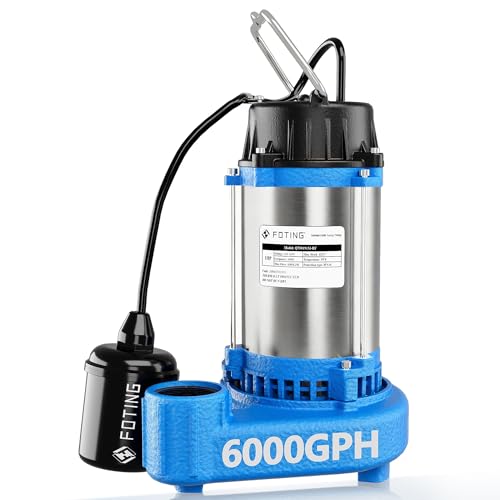
Best for: General residential sewage pumping when the listed 1.5-inch discharge fits the planned plumbing. The product details specify a 1HP motor, flow up to 6,000 GPH, and lift up to 32 feet. A tethered float switch provides automatic on-and-off operation, and the casing combines cast iron and stainless steel.
Its anti-clogging design is described as a feature, but no cutting blade or grinder mechanism is specified. It is therefore a less direct match for buyers who specifically require a grinder pump. Confirm the required discharge size, lift, and solids-handling needs before choosing it.
FOTING 1HP 5600 GPH Pump

Best for: Buyers who value a replaceable float switch and adjustable automatic operation. FOTING lists a 1HP motor, maximum flow of 5,600 GPH, lift up to 32 feet, a 2-inch NPT discharge, and a 10-foot power cord. The detachable float switch is described as replaceable.
The serviceable float is a useful distinction when comparing these options. However, the available details do not establish that this model has a grinder cutter. It may be appropriate for sewage pumping only when the pump’s specified solids handling matches the system; verify this before treating it as a grinder-pump substitute.
Buying Guide
Do you need a grinder pump or a sewage pump?
A grinder pump uses a cutting mechanism to reduce solids before pumping. A sewage or effluent pump may handle solids without grinding them. Product descriptions such as “anti-clogging” or “vortex impeller” do not by themselves confirm a grinder. Look for an explicit cutter or grinder specification and ask the manufacturer about approved tank use.
How much lift and flow does the system require?
Compare the required vertical lift with the pump’s stated maximum head, but do not treat maximum flow and maximum head as simultaneous operating figures. Actual delivery depends on the installation and resistance in the discharge line. Have a qualified installer calculate the operating point for the system.
What should you check before installation?
- Confirm the pump is approved for the intended tank or basin; one listing explicitly prohibits septic-tank use.
- Match the pump’s discharge connection to the planned pipe and fittings.
- Check the float-switch arrangement, available basin space, power-cord length, and electrical requirements.
- Follow instructions for safe lifting. Product listings warn against lifting pumps by their power cords.
Frequently Asked Questions
Can any sewage pump be used as a septic tank grinder pump?
No. A sewage pump is not automatically a grinder pump. Verify that the model has a cutting mechanism and is approved for the intended septic application.
Does a higher GPH rating always mean a better pump?
No. Flow is only one factor. Match the pump’s performance to the required lift, discharge piping, solids handling, and system design.
What does a float switch do?
A float switch turns a pump on and off in response to wastewater level. Check whether it is adjustable and whether the basin has room for its movement.
Should I install a grinder pump myself?
Installation involves wastewater plumbing and electrical equipment. Use a qualified professional when required by local code or when system sizing and wiring are uncertain.