Best Solar Crawl Space Fans for Ventilation and Moisture Control
A solar crawl space fan can help move warm, stale air, but it needs a sunny location for its panel and a suitable opening for airflow. For crawl spaces, the SHENVITASO is the most flexible pick because it includes a household power adapter as well as a solar panel. The ANTEQI is better for continued operation after sunset, while KingMiKi, GTQKING, and DC HOUSE are options for solar-only ventilation. These products are general-purpose ventilation kits, so check dimensions, installation requirements, and crawl space conditions before choosing.
| Product | Best suited for | Key feature |
|---|---|---|
| SHENVITASO Solar Exhaust Fan | Day-and-night power flexibility | Solar panel and power adapter |
| ANTEQI Solar Fan | Ventilation after sunset | Battery and timer |
| KingMiKi Solar Exhaust Fan | High stated airflow | 430 CFM and 25W panel |
| GTQKING Solar Fan | Wet outdoor settings | IPX7-rated fan motors |
| DC HOUSE Solar Fan | Small spaces and simple installation | Plug-and-play connector |
SHENVITASO Solar Exhaust Fan

Best for: Buyers who want solar ventilation with an alternative power option. This kit pairs a 25W panel with an 8-inch fan and includes a power adapter, which can provide another way to run the fan when sunlight is unavailable. The product listing states 430 CFM airflow, a 16.4-foot panel cord, and an anti-backflow valve designed to help keep insects and animals out when the fan stops.
Choose this model if the panel can be positioned in sunlight while the fan is installed at a crawl space opening. The adapter makes it more flexible than a solar-only option, but the listing does not establish how the adapter should be wired in a particular crawl space. Confirm the installation method and opening dimensions before purchase.
ANTEQI Solar Fan With Battery And Timer

Best for: Buyers who want airflow to continue after daylight. The kit includes a 25W solar panel and a 15,000mAh battery. Its listing says a full charge requires six to seven hours of sunlight and can support 12 to 15 hours of operation. A timer can be set for three or six hours, though the timer function is specified for nighttime use.
The dual-airflow design supports intake or exhaust, giving buyers options for directing air movement. This is a useful choice when a crawl space needs ventilation beyond peak sun hours. However, battery runtime depends on the stated full-charge conditions, and the product information does not specify crawl-space-specific installation instructions.
KingMiKi 25W Solar Exhaust Fan
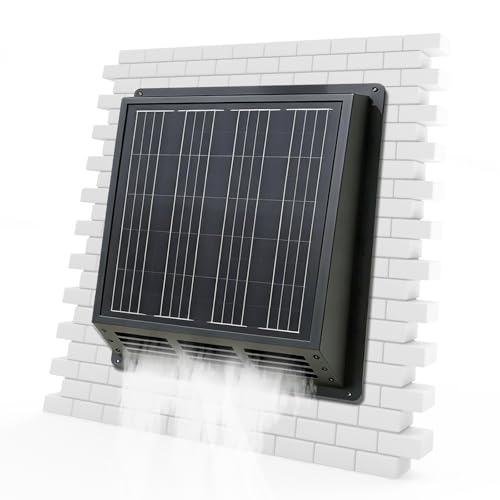
Best for: Buyers comparing solar fans by stated airflow. KingMiKi lists 430 CFM and 2,500 RPM, driven by a 25W monocrystalline solar panel. It is described for uses including attics, garages, RVs, sheds, coops, and greenhouses. Its weather-resistant housing and waterproof motor are intended for outdoor conditions.
Choose this model if you want a solar-powered fan with a high stated airflow figure and do not need battery-backed operation. The listing says it starts with sunlight and stops at dusk, so it is not the best fit if continuous overnight ventilation is required. Verify that the panel can receive adequate direct sun at the proposed installation site.
GTQKING 30W Solar Fan

Best for: Buyers who prioritize weather protection for an outdoor fan. This kit uses a 30W monocrystalline panel and two 5-inch fans. The listing describes the motors as IPX7 waterproof and says the fans can be used for intake or exhaust. That versatility can help when planning airflow through a small crawl space or nearby vent opening.
The 30W panel is a higher stated wattage than the panels on several other listed kits, but wattage alone does not establish actual airflow or crawl-space performance. The product listing focuses on small spaces such as coops, sheds, and greenhouses rather than crawl spaces. Check whether the fan arrangement and mounting dimensions suit the intended opening.
DC HOUSE 20W Solar Fan Kit

Best for: Buyers ventilating a small area who want a simple solar connection. The kit has two fans, a 20W solar panel, and a waterproof plug-and-play connector. The manufacturer identifies an applicable space of up to 880 cubic feet and describes pre-drilled panel mounting holes. It is designed to run on solar energy without mains electricity.
This option may suit a small crawl space if its airflow and mounting arrangement match the site. The listing emphasizes sheds, pet houses, coops, and greenhouses, not crawl-space-specific performance. It also relies on solar power, so avoid choosing it for a location where the panel cannot receive adequate sunlight and overnight operation is essential.
Buying Guide: How To Choose A Solar Crawl Space Fan
Will the solar panel receive direct sunlight?
Panel placement is a primary consideration. A crawl space is often shaded or enclosed, so a solar fan may need its panel mounted outside and connected to the fan with a cable. Check the cable length, mounting options, and the path between the panel and the vent before buying. Shade, roof direction, and seasonal sunlight can affect how consistently a solar-only fan runs.
Do you need ventilation after sunset?
Solar-only models generally depend on available sunlight. If airflow is needed at night, consider a product with a battery or an alternate power adapter. The ANTEQI listing specifies battery operation after charging, while the SHENVITASO includes a power adapter. Confirm the power setup meets your needs rather than assuming every solar fan can run continuously.
How much airflow does the crawl space need?
Compare the stated airflow figures when available, but do not treat them as a complete sizing recommendation. A fan’s suitability also depends on crawl-space volume, vent placement, obstructions, and whether the fan is exhausting air or supplying it. Some products in this list do not provide a CFM figure, so compare specifications carefully.
Is a solar fan appropriate for moisture problems?
A fan can move air, but it does not by itself establish or correct the cause of crawl-space moisture. Consider drainage, ground moisture, existing vents, and local building requirements. If the area has persistent dampness, mold, or suspected soil gas, a qualified professional can help determine an appropriate ventilation approach.
Frequently Asked Questions
Can a solar fan work in a crawl space?
Yes, if the fan can be mounted at an appropriate opening and its panel can receive sunlight. The listed products are general-purpose kits rather than crawl-space-specific models, so verify fit and installation requirements.
Will a solar crawl space fan run at night?
A solar-only fan generally needs sunlight to operate. A model with a battery or alternate power source may continue running after sunset, subject to its listed operating conditions.
Does a solar fan remove crawl-space humidity?
A fan can help exchange air, but ventilation alone may not resolve the source of moisture. Evaluate drainage, ground vapor, and other conditions if humidity persists.
What should I check before installation?
Measure the opening, review the fan and panel dimensions, check cable reach, identify a sunny panel location, and confirm how the fan is powered. Also review local requirements for crawl-space ventilation.