Best Solar Powered Well Pumps for Off-Grid Water Supply
The best solar powered well pump depends on well depth, required water flow, sunlight, and whether you need a complete panel kit. The ECO-WORTHY 400W kit is best for automated farm or home water storage, while its 200W kit suits buyers who want a balanced setup with battery flexibility. For a simpler, lower-output system, consider the 100W ECO-WORTHY kit. The Bghdas and JENENSERIES 48V pumps are options for buyers prioritizing greater stated lift and a separate system configuration.
| Product | Best For | Key Listed Specification |
|---|---|---|
| ECO-WORTHY 400W Kit | Automatic tank filling | Max 164 ft head; 5.6 GPM |
| ECO-WORTHY 200W Kit | Flexible off-grid pumping | Max 230 ft head; 3.2 GPM |
| ECO-WORTHY 100W Kit | Lower-flow watering | Max 230 ft head; 1.6 GPM |
| Bghdas 500W Pump | High-lift applications | Max 393 ft head; 7.9 GPM |
| JENENSERIES 48V Pump | Solar or battery-supported use | Max 393 ft head; 7.9 GPM |
ECO-WORTHY 400W Solar Deep Well Pump Kit

This kit is best for buyers who want solar panels, a submersible pump, and automatic water-level management in one package. It includes four 100W solar panels and a 140W, 3-inch stainless steel screw pump with a built-in MPPT controller and liquid-level sensor. The sensor is designed to stop operation when the tank is full or well water is too low.
The listed maximum head is 164 feet, with a maximum flow rate of 5.6 GPM. Actual flow decreases as pumping head increases, so compare the well lift and delivery height with the pump’s specifications before choosing it. Its automation features make it a stronger fit for tank filling than a basic pump without level sensing.
ECO-WORTHY 200W Solar Well Pump Kit

Choose this if you want a kit with two solar panels and the option to use a 12V battery for energy storage. It includes two 100W monocrystalline panels, a 12V stainless steel pump, cables, and a 20A PWM controller with an LCD. The controller displays charging information and includes overcharge, over-discharge, short-circuit, and reverse-polarity protection.
The pump is listed at up to 230 feet of head and 3.2 GPM. It has a 304 stainless steel housing, an IP65 rating, and built-in overheat protection. It is best for moderate water needs where a bundled panel-and-controller setup is useful. Keep in mind that the stated maximum flow and maximum head are separate limits; flow changes with lift and available sunlight.
ECO-WORTHY 100W Solar Well Pump Kit

This is best for buyers with lower water-flow needs, such as small-scale irrigation or remote tank filling. The listed maximum lift is 230 feet and maximum flow is 1.6 GPM. The pump can connect directly to a solar panel or work with a compatible 12V battery and controller for more stable operation.
Unlike the 200W kit above, this option lists a single 100W panel and lower maximum flow. The product information emphasizes that sunlight intensity affects output and that shading can interfere with panel operation. Choose it if your water demand is modest and the panels can receive clear sunlight; avoid it if you need higher flow for frequent or large-volume use.
Bghdas 500W High-Lift Solar Pump

For buyers comparing pumps by stated lift, the Bghdas 500W, 48V model lists a maximum head of 393 feet and maximum flow of 7.9 GPM. It has a 3-inch diameter, stainless steel construction, and an MPPT controller with a stated PV input range of 42–100V. A water-shortage sensor is designed to stop the pump when water is unavailable, and an LED display shows operating status.
This pump is best for a system designer who needs the listed high-head specification and can plan the supporting solar equipment. The product description does not list solar panels as included, so confirm what additional components your setup requires. Maximum head and maximum flow should not be assumed to occur simultaneously.
JENENSERIES 48V Solar Deep Well Pump
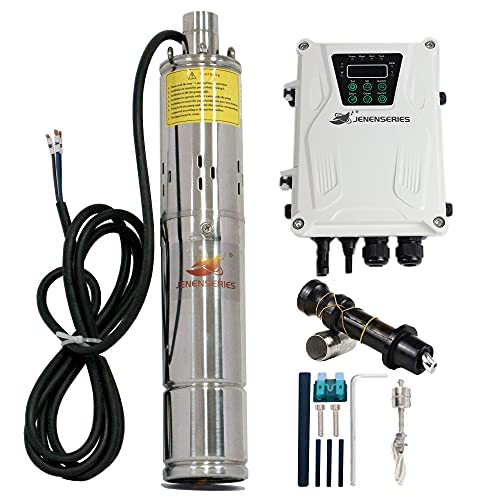
The JENENSERIES pump is best for buyers seeking a 48V, 3-inch submersible model that can be supported by solar panels or batteries. It lists a maximum head of 120 meters and a maximum flow of 1.8 cubic meters per hour, with an MPPT controller and a water-shortage sensor that automatically stops the pump when the well is dry. The listed cable extension is 9.8 feet.
Compared with the bundled ECO-WORTHY kits, this product description focuses on the pump and controller rather than a complete panel package. Verify panel, battery, wiring, and installation needs before purchase. Its flow and head specifications are maximum values, so expected output depends on the actual system conditions.
Buying Guide: How To Choose A Solar Powered Well Pump
How deep is the water source?
Start with the vertical lift from the water level to the outlet or storage tank, then account for the delivery height and system layout. Compare that requirement with the pump’s maximum head. Maximum head is a limit, not a promise of strong flow at that height. Ask the manufacturer for a performance curve if you need a specific flow at a particular lift.
How much water do you need?
Estimate daily use for irrigation, livestock, household supply, or tank filling. Compare the required volume with the listed flow rate, but remember that solar output varies with sunlight and pump flow can fall as head increases. Higher listed wattage alone does not establish that a pump will meet your daily water target.
Do you need panels, a battery, or automatic controls?
A kit that includes panels and a controller can simplify component selection. Battery support can provide more flexibility when sunlight varies, but confirm battery requirements and system voltage. A tank-level or water-shortage sensor can reduce the need for manual monitoring. Check whether panels are included: some pump listings describe an MPPT controller without supplying solar panels.
What should you check before installation?
- Confirm pump voltage, panel or controller input range, and any battery requirements.
- Measure well casing diameter and check pump dimensions and outlet details.
- Plan cable length, mounting, water delivery route, and safe electrical connections.
- Keep panels unobstructed; shading can reduce solar output.
- Check whether the included accessories match your well, tank, and irrigation layout.
Frequently Asked Questions
Can a solar well pump run without a battery?
Some systems can connect directly to solar panels. Output then depends on sunlight, and pumping may vary during cloudy periods or low-light hours. Check the specific pump and controller instructions.
Does maximum head mean the pump delivers its maximum flow at that height?
No. Maximum head and maximum flow are separate stated limits. Flow generally changes with lift and system conditions, so use a performance curve when sizing for a particular well.
Are solar panels included with every pump?
No. Some products are complete panel kits, while others list a pump and controller without panels. Review the included-components list before buying.
What does an MPPT controller do?
An MPPT controller manages the connection between the solar array and pump to make use of available solar power. The listed input-voltage range must suit the solar array.
Why choose a pump with a water-level sensor?
A water-shortage sensor can stop a pump when water is too low, while a tank sensor can stop it when a storage tank is full. These controls can help automate operation and limit dry-running.