Best Through the Wall Air Conditioner Units for American Homes
The best through-the-wall air conditioner depends on your room size and existing wall sleeve. The LG 10,000 BTU model suits rooms up to 440 square feet, while the LG 11,800 BTU unit is intended for areas up to 530 square feet. For smaller rooms, consider the Durastar 8,000 BTU model; the Keystone and Whirlpool 10,000 BTU units offer additional airflow or moisture-removal features. Check sleeve dimensions and installation requirements before choosing.
| Model | Listed Coverage | Best For |
|---|---|---|
| LG 10,000 BTU | Up to 440 sq. ft. | Bedrooms and living rooms |
| LG 11,800 BTU | Up to 530 sq. ft. | Larger rooms |
| Durastar 8,000 BTU | 300–350 sq. ft. | Smaller spaces with timer controls |
| Keystone 10,000 BTU | Up to 450 sq. ft. | Cooling with dehumidification |
| Whirlpool 10,000 BTU | Up to 450 sq. ft. | Flexible airflow and sleeve fit |
LG 10,000 BTU Through-the-Wall Air Conditioner

Best for: Bedrooms, apartments, and living rooms up to 440 square feet. This LG unit is designed for through-the-wall installation, not standard window installation, so it is a better choice when a compatible wall opening is available.
Features include three cooling speeds, three pre-programmed modes, a remote, and four-way air deflection. Energy Saver mode stops the compressor when the set temperature is reached while continuing to circulate air. Dry mode is listed as removing up to 2.9 pints of moisture per hour. The product information gives a 10.7 EER and R-32 refrigerant.
Limitation: The feature details identify the cooling capacity as 9,800 BTU, although the product name says 10,000 BTU. Confirm the specifications before purchase, and do not use it as a standard window unit.
LG 11,800 BTU Through-the-Wall Air Conditioner

Best for: Larger rooms listed at up to 530 square feet. Choose this LG model if you need more stated cooling capacity than the 10,000 BTU option and have a suitable wall installation.
It has three cooling speeds, three pre-programmed modes, a turbo fan, and R-32 refrigerant. The listed EER is 10.6. Product dimensions are 24 inches wide, 20.1 inches deep, and 14.4 inches high, and the listing describes a universal design intended to fit most sleeves.
Limitation: “Most sleeves” does not guarantee a match with every existing sleeve. Measure the opening and compare it with the unit dimensions before ordering. The product is not properly vented for standard window installation.
Durastar 8,000 BTU Through-the-Wall AC

Best for: Smaller rooms of about 300 to 350 square feet. The Durastar is a practical option when you want lower listed capacity and convenient scheduling features rather than a unit intended for a larger area.
It includes a remote, digital display, sleep mode, energy-saver feature, and a 24-hour timer. Its listed temperature range is 62°F to 86°F, and its EER is 10.6. The product information specifies compatibility with the Durastar wall air conditioner sleeve, which is sold separately.
Limitation: The sleeve is not included. Check whether you need to purchase the specified sleeve separately and verify the installation dimensions before selecting this model.
Keystone 10,000 BTU Wall Air Conditioner
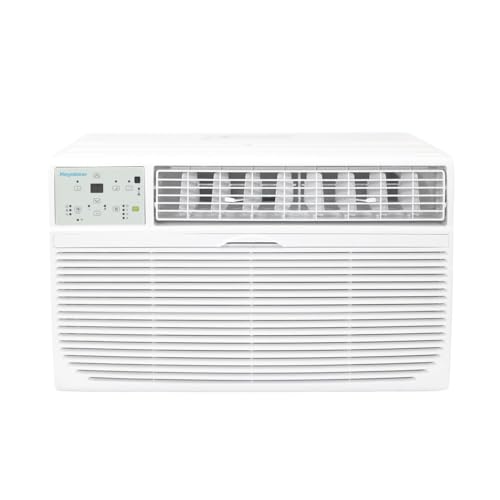
Best for: Small-to-medium rooms up to 450 square feet where dehumidification is useful. This unit combines cooling with a built-in system listed to remove 2.3 pints of moisture per hour.
Features include three cooling modes, three fan speeds, four-way adjustable air louvers, a programmable timer, and a universal interior trim kit. Its through-the-wall design preserves window space and floor area, making it worth considering for apartments or rooms where a window unit is not preferred.
Limitation: The product details do not provide the unit’s full dimensions or an EER. Check the measurements and electrical requirements against your installation before buying.
Whirlpool 10,000 BTU Wall Air Conditioner

Best for: Rooms up to 450 square feet where adjustable airflow and sleeve fit are priorities. The unit has eight-way directional louvers, three fan speeds, and four operating modes.
Its listed temperature setting range is 62°F to 86°F. The dimensions are 20.3 inches deep, 24.2 inches wide, and 14.5 inches high. The listing says it fits sleeves 24.5 to 27 inches wide and includes a trim kit and rear grille. It also has a 5.9-foot LCDI three-prong plug for a 115V outlet.
Limitation: Confirm that your sleeve falls within the stated width range and that the depth and height also work for your opening.
Buying Guide: How to Choose a Through-the-Wall AC
How much cooling capacity does the room need?
Start with the room’s square footage and compare it with the manufacturer’s listed coverage. The models here range from 8,000 BTU for spaces around 300 to 350 square feet to 11,800 BTU for areas listed up to 530 square feet. Room layout and conditions can affect cooling needs, so treat coverage figures as a starting point rather than a guarantee.
Will the unit fit your wall opening or sleeve?
Measure the sleeve’s width, height, and depth, then compare those measurements with the product specifications. A “universal” or “most sleeves” description does not confirm fit in every installation. Check whether a sleeve is included; the Durastar listing, for example, says its compatible sleeve is sold separately.
What electrical and installation details matter?
Check the stated voltage and plug requirements, along with any installation instructions. These products are designed for through-the-wall use; some listings explicitly warn that the units are not properly vented for standard window installation. If you are replacing an existing unit, verify that the new model is suitable for the opening and installation setup.
Which extra features are useful?
Choose a remote if you want to adjust settings from across the room. Timers and sleep modes can help schedule operation, while adjustable louvers let you direct airflow. If humidity is a concern, compare the listed moisture-removal rates rather than assuming every cooling unit has the same dehumidification performance.
Frequently Asked Questions
Can a through-the-wall air conditioner go in a window?
Not necessarily. Some through-the-wall models are not properly vented for standard window installation. Follow the product’s installation guidance and choose a window unit if the model is not approved for that setup.
Do through-the-wall AC units need a sleeve?
Many installations use a wall sleeve, but whether it is included or sold separately depends on the model. Check the product details and confirm compatibility with your existing sleeve before purchase.
Is a higher BTU rating always better?
No. Select capacity based on the room and the manufacturer’s coverage guidance. The highest-capacity model is not automatically the best match for a smaller space.
What should I measure before buying?
Measure the wall opening or sleeve’s width, height, and depth. Also check the unit’s dimensions, voltage, and plug requirements.
Can these units also heat a room?
The five models compared here are presented as air conditioners. Do not assume they provide heating unless the specific product listing clearly includes that function.