Best Ultraviolet Water Filter Systems for Whole-House Purification
Ultraviolet (UV) water filtration provides chemical-free disinfection for households, helping to reduce bacteria, viruses, and other pathogens. This guide compares top UV systems that fit whole-house needs, emphasizing flow rate, lamp design, and ease of installation. Whether upgrading an existing filter or starting fresh, the right UV purifier can add an extra layer of protection without altering water taste or chemistry.
Summary of Selected Products
| Product | Brand | Key Benefit | Typical Flow |
|---|---|---|---|
| HQUA-TWS-12 Ultraviolet Water Purifier | HQUA | Compact, easy integration; extra lamp and quartz sleeve | 12 GPM |
| iSpring UVF50 LED UV Water Filter System | iSpring | LED UV technology; smart flow sensor | Up to 13.2 GPM |
| APEC Essence UV System | APEC WATER | 7-stage RO with UV for enhanced safety | 75 GPD RO output |
| BLUONICS UV Water Filter System | BLUONICS | High flow and stainless steel chamber | 24 GPM |
| HQUA-OWS-121 UV System | HQUA | Stainless steel, easy installation | 12 GPM |
HQUA-TWS-12 Ultraviolet Water Purifier

The HQUA TWS-12 model delivers 12 GPM with a 55W UV lamp and a compact 21-inch length. Featuring MNPT 3/4″ inlet/outlet connections, its design emphasizes easier integration into existing pipe systems. The unit is marketed as minimizing secondary pollution, with water chemistry remaining unchanged in taste, odor, pH, or conductivity. An extra UV lamp and quartz sleeve are included to support ongoing maintenance, which helps reduce downtime during bulb replacements.
Key specs and considerations:
- Flow capacity: 12 GPM
- Compact size for easier retrofits
- Included spare lamp and quartz sleeve
- 3/4″ MNPT connections
iSpring UVF50 LED UV Water Filter System

The UVF50 from iSpring blends LED UV technology with a long-life LED design and a built-in smart flow sensor. It supports up to 13.2 GPM and uses standard 1-inch FNPT connections for compatibility. Unlike mercury-based lamps, it does not generate heat, odors, or ozone, contributing to a stable overall system. The LED module offers an extremely long service life, with a smart flow switch that activates the unit only when water is flowing, reducing energy use and maintenance downtime.
Key specs and considerations:
- Flow: up to 13.2 GPM
- LED UV technology with no mercury
- Smart flow sensor for on-demand operation
- Long LED life and low maintenance
APEC Essence UV System

The APEC Essence system combines high-quality filtration with continuous UV sanitation. It is designed to remove up to 99% of a broad range of contaminants, including arsenic, chlorine, lead, fluoride, heavy metals, and viruses. The unit uses premium long-lasting filters and provides an additional layer of microbial protection with UV treatment, enhancing the safety of drinking water and improving overall taste and odor profiles compared to standard filtration alone.
Key specs and considerations:
- 7-stage filtration with UV sanitation
- Removes 99% of many contaminants
- Designed for reliable, long-term performance
- Suitable for tap and well water inputs
BLUONICS UV Water Filter System

This BLUONICS unit emphasizes power and flow, featuring a 110W UV lamp and a 24 GPM maximum flow rate. The stainless steel chamber supports 1″ NPT inlet/outlet connections, and the design is presented as reliable for both residential and commercial settings. The unit highlights a chemical-free operation with no chlorine and no changes to pH, taste, or color, making it a straightforward upgrade for homes requiring higher throughput without compromising water quality.
Key specs and considerations:
- Flow up to 24 GPM
- 110W UV lamp in a stainless steel chamber
- 1″ NPT connections
- Chemical-free disinfection
HQUA-TWS-121 12GPM UV System
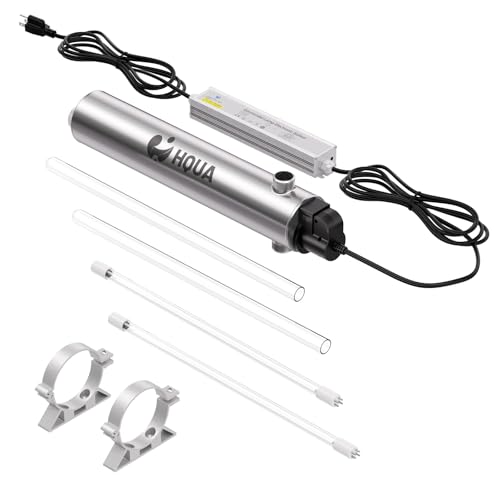
The HQUA-TWS-121 expands the 12 GPM family with a 21-inch long, 3.5-inch diameter chamber and 1″ MNPT inlet/outlet. The design emphasizes a compact footprint for easier installation and integration into existing piping, while maintaining water taste, odor, pH, and conductivity. An extra bulb and sleeve are included to support maintenance, helping keep UV performance consistent over time.
Key specs and considerations:
- 12 GPM flow with 21″ by 3.5″ dimensions
- 1″ MNPT connections
- Includes spare UV bulb and quartz sleeve
Buying Guide: Key Purchase Considerations For Ultraviolet Home Systems
- Flow requirements: Match the UV unit’s GPM rating to your household demand. Higher flows require larger chambers or multiple units in parallel to ensure effective disinfection.
- Lamp technology: LED-based UV systems offer long lifespans and reduced maintenance compared with traditional mercury lamps. Consider systems with smart flow sensors to minimize energy use.
- Installation: Check inlet/outlet sizing (commonly 1″ or 3/4″ connections) and whether the unit is designed for horizontal or vertical mounting. Ease of attachment to existing pipes is important for retrofit projects.
- Maintenance: Look for spare bulbs and quartz sleeves included or readily available, and note suggested replacement intervals. Some models provide longer service life with minimal downtime.
- Safety and water chemistry: UV disinfection does not alter taste, odor, pH, or general chemistry. It complements other filtration stages, especially RO or sediment filters, by providing microbial safety without adding chemicals.
- System integration: For homes with multi-point filtration or whole-house needs, ensure the UV unit fits within the overall water treatment design and that adapters are available for standard pipe sizes.
- Certifications and testing: Seek units with third-party validation for UV intensity and dose, ensuring consistent disinfection performance under typical household flows.
- Cost of ownership: Consider initial cost, bulb/lamp replacement needs, energy use, and maintenance frequency to estimate long-term operating expenses.