Best UV Reverse Osmosis Systems for Cleaner Drinking Water
The best UV reverse osmosis system combines RO filtration with ultraviolet treatment for an additional water-treatment stage. The iSpring RCC7AK-UV is best for buyers seeking a certified system with alkaline remineralization; OEMIRY suits those looking for high stated output and eight-stage filtration; and the iSpring RCC1UP-AK is a better fit when a booster pump is a priority. Tankless and alternative under-sink options are also included below.
| System | Best For | Standout Feature |
|---|---|---|
| iSpring RCC7AK-UV | Certification and remineralization | Whole-system NSF/ANSI 58 and 372 certification |
| OEMIRY UV RO | High stated daily output | 500 GPD and eight filtration stages |
| iSpring RCC1UP-AK | Lower-pressure conditions | Booster pump and UV filter |
| SimPure T1-400 | Saving under-sink space | Tankless design and flow-activated UV |
| APEC ROES-PHUV75 | Alkaline and UV treatment | Seven-stage filtration |
iSpring RCC7AK-UV

Best for: Households that want UV treatment, alkaline remineralization, and whole-system certification in one under-sink setup. iSpring states that the complete system is NSF/ANSI 58 and 372 certified, rather than relying only on certification of individual components.
The seven-stage system uses layered filter cartridges and an LED UV stage. Its UV light activates when water flows, and the manufacturer describes the design as mercury-free and maintenance-free. An alkaline stage is included for remineralization.
Choose this if certification and a flow-activated UV stage are key priorities. Limitation: The listed features do not provide a daily production rating, so buyers comparing output should confirm that detail before choosing.
OEMIRY Stainless Steel 500GPD
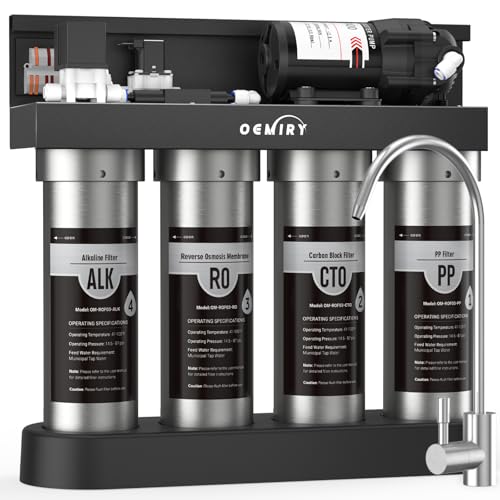
Best for: Buyers prioritizing a high stated production capacity and alkaline remineralization. OEMIRY lists 500 gallons per day and eight filtration stages, including UV and an alkaline mineralization filter.
The manufacturer says the system targets contaminants including fluoride, nitrates, PFAS, lead, arsenic, and microplastics. Treat these as manufacturer claims and check the product documentation for the specific reduction data relevant to your water. The alkaline stage is described as restoring minerals such as calcium, magnesium, and potassium.
Choose this if you want a higher-capacity system with mineralization. Limitation: It requires an electrical outlet under the sink and has specified operating temperature and pressure ranges. Check your installation conditions before buying.
iSpring RCC1UP-AK With Booster Pump

Best for: Buyers who want a booster pump alongside UV filtration and alkaline remineralization. This seven-stage system has a listed capacity of 100 GPD. The pump pressurizes water through the RO membrane, which the manufacturer says can improve efficiency and reduce wastewater compared with pumpless models.
Listed reduction targets include PFAS, chlorine, fluoride, lead, and arsenic. Its UV filter uses a smart flow sensor and a three-minute delay, according to the product details.
Choose this if you want a pump-assisted RO setup and the added stages. Limitation: The system requires space and power for its pump and UV components; confirm under-sink clearance and access to an outlet.
SimPure T1-400 Tankless RO

Best for: Kitchens where under-sink storage space matters. The T1-400 is a tankless system with a stated capacity of 400 GPD and UV treatment that operates automatically based on water flow pressure.
SimPure says the system was independently tested by SGS against NSF/ANSI 58 and describes removal of more than 1,000 contaminants. The listed features also describe TDS reduction and near-zero TDS results under specified conditions; actual water quality can vary with feed water and installation.
Choose this if you prefer a tankless design and automatic UV operation. Limitation: The listed features do not include alkaline remineralization, so consider another option if you specifically want that stage.
APEC ROES-PHUV75

Best for: Buyers seeking a seven-stage under-sink system with both UV treatment and alkaline filtration. APEC lists a 75 GPD capacity and says its system targets arsenic, chlorine, lead, fluoride, heavy metals, and other impurities.
The product features describe long-lasting filters and suitability for tap and well water. Its UV stage provides additional treatment for living impurities, while alkaline filtration offers a different feature set from a system focused on RO and UV alone.
Choose this if you want a conventional under-sink format with UV and alkaline stages. Limitation: The listed capacity is lower than the 100, 400, and 500 GPD figures given for some other picks.
Buying Guide: How To Choose A UV RO System
What does UV add to reverse osmosis?
Reverse osmosis uses a membrane and supporting filters to reduce dissolved substances and other contaminants. A UV stage adds ultraviolet treatment, which is intended to address microorganisms. It does not replace the RO membrane, and the product features provided do not establish that every system is suitable for every water source. Review the manufacturer’s documentation and test your water when necessary.
Do you need a tankless system or a storage tank?
A tankless design, such as the SimPure, can save under-sink space. Systems with storage tanks may suit buyers who prefer stored filtered water, but the supplied product details do not specify tank sizes for the selected models. Compare the complete installation dimensions, faucet arrangement, and expected household demand before purchasing.
Is alkaline remineralization important?
Choose a model with an alkaline stage if you want minerals added back after RO filtration. The iSpring RCC7AK-UV, iSpring RCC1UP-AK, OEMIRY, and APEC picks include alkaline or remineralization features. The SimPure listing does not specify one. Remineralization is a preference and feature comparison, not proof of a health benefit.
What should you check before installation?
Confirm that the system fits your cabinet, that an outlet is available when required, and that your water pressure and temperature fall within the stated operating range. Check filter replacement instructions and included fittings as well. Some systems have flow-activated UV, while the OEMIRY listing specifically notes its electrical requirement and operating limits.
Frequently Asked Questions
Does every reverse osmosis system include UV?
No. Look for UV or ultraviolet treatment explicitly listed in the system features. The products in this comparison include a UV stage, but other RO systems may not.
Does UV filtration remove dissolved solids?
UV treatment is a separate stage from RO filtration. These product listings describe RO as the stage that reduces dissolved substances, while UV provides additional treatment aimed at microorganisms.
Which system is best for limited under-sink space?
The SimPure T1-400 is the tankless pick in this comparison and is designed to save under-sink space. Verify its dimensions and installation requirements before buying.
Which options include alkaline remineralization?
The iSpring RCC7AK-UV, iSpring RCC1UP-AK, OEMIRY, and APEC systems list alkaline or remineralization features. The SimPure listing does not specify this feature.
Do UV RO systems need electricity?
UV components require power to operate. The OEMIRY listing explicitly requires an electrical outlet under the sink; check each product’s installation instructions for its specific power requirements.