Best Wall Expansion Joint Covers and Sealants for Common Wall Gaps
The best choice depends on whether you need to seal a moving construction joint, cover a roof-to-wall transition, or finish a pipe opening. DCP Donseal PU440 is best for filling concrete and other material joints; Fasteners Plus EPDM is designed for flashing transitions; and MYFAMIREA backer rod supports caulk in measured gaps. The exablo sleeve and Seimneire escutcheons are pipe-opening covers, not structural expansion-joint systems.
| Product | Best suited for | Product type |
|---|---|---|
| DCP Donseal PU440 | Sealing horizontal or vertical joints | Polyurethane sealant |
| Fasteners Plus EPDM Linear Expansion Joint | Roof and wall transitions | EPDM flashing |
| MYFAMIREA Backer Rod | Backing caulk in narrow gaps | Joint filler |
| exablo Mini Split Line Set Cover | Finishing a mini-split wall penetration | PVC sleeve and wall cap |
| Seimneire Plastic Pipe Covers | Hiding gaps around small water pipes | Decorative escutcheons |
DCP Donseal PU440 Polyurethane Sealant

Best for: Filling concrete expansion joints and sealing wall or foundation joints where a flexible, non-sag sealant is needed. This two-pack product is a polyurethane sealant that cures through a reaction with air humidity and forms an elastic joint material.
Its listed applications include concrete, wood, gypsum board, aluminum, steel, and ceramic. It can be used on horizontal construction joints and vertical surfaces such as basement walls. The stated service temperature range is -22°F to 175°F, which may help buyers comparing products for varied jobsite conditions.
Limitation: This is a sealant, not a rigid cover plate or a preformed flashing strip. Choose it if you need to fill a joint; avoid treating it as a visible mechanical cover. Follow the manufacturer’s application directions for joint preparation and sizing.
Fasteners Plus EPDM Linear Expansion Joint

Best for: Buyers who need a broad EPDM flashing material for a roof or building-envelope transition rather than a caulked gap. The listed roll measures 9 inches wide by 50 feet long, is gray, and is described as ozone resistant.
Potential applications include transition walls, parapet walls, stepped roofs, corrugated metal roofs, roof penetrations, expansion joints, and skylights. It is the most relevant option in this list when the project calls for linear flashing across a transition area.
Limitation: The product information does not specify installation details, fasteners, or compatibility with particular roofing systems. Confirm that the material and installation method suit the project before using it as a wall or roof-joint cover.
MYFAMIREA EPDM Backer Rod

Best for: Supporting sealant in a gap before caulking. This 1/4-inch-diameter, 100-foot backer rod is made from closed-cell EPDM rubber, which the listing describes as flexible, non-absorbent, and weather resistant.
The listed uses include wall, pavement, foundation, and panel cracks. A backer rod can help fill space behind caulk, so it is a practical companion material when a joint is too deep to fill with sealant alone. Measure the opening first and compare it with the rod diameter.
Limitation: Backer rod is not an exposed cover or a finished seal by itself. It is intended to sit inside the gap and support another sealing material. Its 1/4-inch diameter may not suit wider joints.
exablo Mini Split Line Set Wall Sleeve

Best for: Finishing and protecting the wall opening where mini-split lines pass through. The PVC sleeve is listed at 7.87 inches long, with a 2.76-inch inner diameter and approximately 2.86-inch outer diameter. The kit is described as protecting insulated copper pipes, communication cables, and drain hoses.
The sleeve can be trimmed for a custom wall thickness. Its smooth interior is intended to help prevent scratches, while the decorative cap creates a finished appearance. The listing also describes the PVC as resistant to moisture, sunlight, and temperature extremes.
Limitation: This covers a line-set penetration; it is not designed as a building expansion-joint cover. Check the opening and line bundle dimensions before selecting it.
Seimneire Plastic Pipe Cover Escutcheons
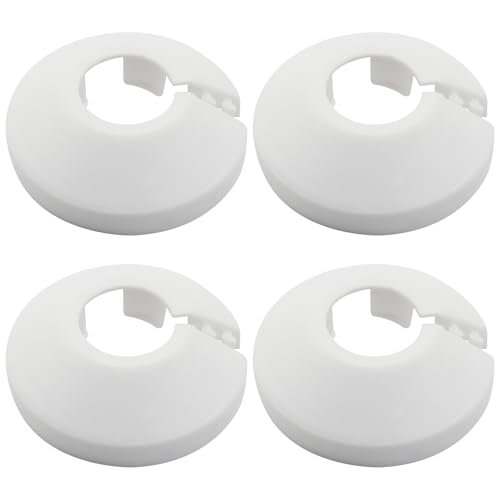
Best for: Hiding small gaps around plumbing pipes, valves, and outlets in bathrooms, kitchens, and utility areas. This four-pack of white plastic escutcheons is listed for 1/2-inch pipes with a 16 mm (5/8-inch) inner diameter.
These covers provide a simple decorative finish around supply lines and drain pipes. Choose them when the main goal is to conceal the opening around a pipe, rather than seal a moving wall joint or protect a large building transition.
Limitation: The listing identifies these as decorative covers, not waterproof expansion-joint components. Confirm the pipe diameter and opening size; the product is intended for small plumbing penetrations.
Buying Guide: How To Choose A Wall Joint Cover
Do you need a seal, flashing, or a decorative cover?
Start by identifying the job. Use polyurethane sealant for a gap that needs a flexible, continuous bead. Consider EPDM flashing for a linear roof or wall transition. Use backer rod as internal support beneath sealant, not as the finished surface. Pipe sleeves and escutcheons conceal penetrations, but they are not substitutes for expansion-joint systems.
How should you measure the opening?
Measure the joint width and depth at several points, since openings may vary along a wall. For backer rod, compare the gap width with the listed 1/4-inch diameter. For a pipe cover or sleeve, check the pipe or line-bundle size and the wall opening. The exablo sleeve can be trimmed, but its listed inner diameter still matters.
What should you compare before buying?
- Movement and location: Identify whether the gap is a moving construction joint, a roof transition, or a pipe penetration.
- Material: Match sealant, EPDM flashing, or PVC to the intended application and surrounding surfaces.
- Exposure: Consider moisture, sunlight, temperature, and whether the area is horizontal or vertical.
- Installation role: Distinguish the primary cover or seal from backing material such as backer rod.
Frequently Asked Questions
Can a pipe escutcheon cover a wall expansion joint?
No. An escutcheon is a decorative plate for a pipe opening. It does not function as a flexible cover for a long, moving construction joint.
Is backer rod a complete expansion-joint seal?
No. Backer rod fills part of a joint and supports sealant. It is not intended to be the exposed finished seal by itself.
Which listed product is intended for vertical joints?
DCP Donseal PU440 is listed for horizontal and vertical applications, including basement walls. Confirm that the joint and surface conditions match the product directions.
Can the mini-split sleeve replace wall-joint flashing?
No. The exablo sleeve is intended to protect and finish a mini-split line-set passage through a wall, not to cover a building expansion joint.
What should I check before using EPDM flashing?
Check the transition dimensions and confirm that the flashing and installation method are suitable for the specific roof or wall assembly. The product listing names applications but does not provide system-specific installation guidance.