Best Reverse Osmosis Water Purifiers for Home Use
The best reverse osmosis water purifier depends on where you want to use it and how much water you need. For a countertop without plumbing, compare the DREO for monitoring and autofill, Aigerri for its stated water-saving ratio, Bluevua for UV and a glass carafe, and AquaTru for its four-stage system. Choose the iSpring if you want an under-sink unit with a dedicated faucet and mineral stage.
| Product | Best For | Key Distinction |
|---|---|---|
| DREO Countertop RO | Convenient daily use | TDS monitoring and autofill pitcher |
| Aigerri Countertop RO | Portable use and larger tanks | 5L feed tank and 5:1 pure-to-drain ratio |
| Bluevua RO100ROPOT-UV | UV and glass-carafe preference | Six-stage filtration with UV and remineralization |
| iSpring RCC7AK-BN | Under-sink installation | Six stages and mineral-boost stage |
| AquaTru Glass Carafe | Countertop use with published filter intervals | Four-stage filtration and glass carafe |
DREO Countertop RO With Autofill Pitcher
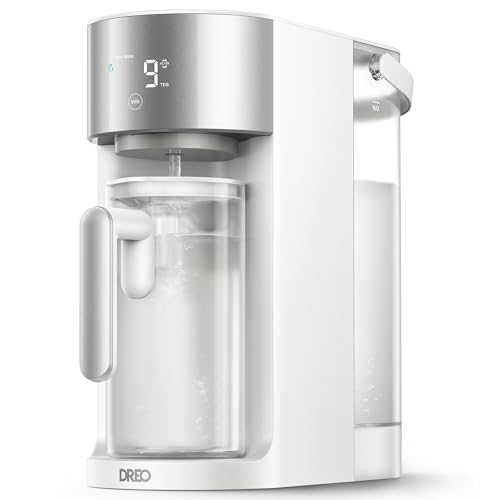
This DREO model is best for households seeking a countertop reverse osmosis system with visible water-quality and maintenance information. Its listed features include real-time TDS readings for raw and purified water, filter-life reminders, and an autofill pitcher sensor.
The manufacturer describes it as a 7-in-1 system and says it filters out 99.9% of possible contaminants, including PFOA, PFOS, chlorine, and fluoride. It also says the product was tested by SGS to meet NSF/ANSI 58 standards. The self-cleaning function flushes internal tubes.
Why choose it: TDS and filter-life displays make routine monitoring more straightforward, while the countertop design avoids plumbing installation. Limitation: This is a powered countertop unit, so it needs a suitable counter location and access to an outlet.
Aigerri Countertop RO With Large Tanks

The Aigerri is best for buyers who want a portable, installation-free purifier with separate feed and purified-water tanks. Its listed capacity is a 5-liter feed tank and a 2-liter purified-water tank. The product description says its PPC and RO filters can provide up to 529 gallons of purified water.
Aigerri lists a 5:1 pure-to-drain ratio and describes the unit as plug-and-play for kitchens, offices, apartments, and RVs. This makes it a useful option when permanent plumbing connections are impractical. The stated ratio is a product specification, not a guarantee of the same result in every use condition.
Why choose it: The larger feed tank and portability suit users who prefer filling a reservoir instead of connecting a water line. Limitation: The unit occupies countertop space, and the purified-water tank holds 2 liters, so frequent use may require refilling or collecting water.
Bluevua RO100ROPOT-UV With Glass Carafe
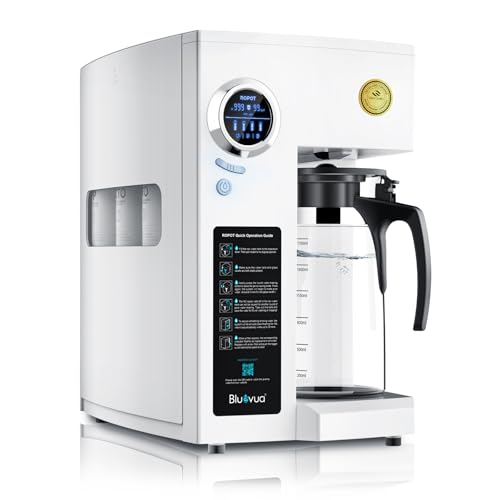
This Bluevua model is best for buyers who want a countertop system combining reverse osmosis, UV light, remineralization, and a glass carafe. Its listed six-stage filtration includes a 0.0001-micron RO membrane, UV, and a remineralization filter.
The product information says it reduces TDS, PFOA, PFOS, chlorine, fluoride, arsenic, and lead. It is listed as WQA-certified against NSF/ANSI/CAN 372 for lead-free materials and tested by SGS. Bluevua also specifies a 2:1 pure-to-drain ratio and an automatic power-saving standby mode.
Why choose it: It is a better fit than a basic countertop RO unit for shoppers prioritizing UV and a glass collection carafe. Limitation: It requires a power source and countertop space, and its glass carafe requires careful handling.
iSpring RCC7AK-BN Under-Sink RO System

The iSpring RCC7AK-BN is best for buyers who prefer an under-sink reverse osmosis system rather than a countertop appliance. It is listed as a six-stage alkaline system with a 75 GPD capacity and a natural-mineral stage intended to add minerals and balance pH.
Its top-mounted fastener is designed to make faucet installation easier from above the sink. A transparent first-stage filter housing lets users see contaminant buildup. These features may appeal to homeowners comfortable with an under-sink setup and routine filter checks.
Why choose it: It provides an installed, under-sink format and includes a mineral stage. Limitation: Unlike the countertop options, it requires under-sink space and installation; check the product instructions and your sink setup before choosing it.
AquaTru Glass Carafe Countertop RO

AquaTru is best for buyers seeking a countertop system with a glass carafe and clearly stated filter replacement intervals. Its four-stage filtration system is described as reducing contaminants such as microplastics, fluoride, chromium-6, arsenic, PFOA, and PFOS. The listing says it is tested and certified to NSF standards by IAPMO.
The product requires no plumbing, drilling, or installation: fill its tank, plug it into a standard outlet, and collect purified water in the carafe. Listed filter intervals include six months or 300 gallons for the pre/carbon filter, one year or 600 gallons for the RO filter, and one year or 300 gallons for the VOC carbon filter.
Why choose it: Its published filter intervals help buyers plan maintenance. Limitation: It needs counter space and an outlet, and filters require replacement according to the listed intervals.
Buying Guide: How To Choose A Reverse Osmosis Purifier
Should you choose a countertop or under-sink system?
Countertop models suit renters, offices, and households that want to avoid plumbing work. They generally need a power outlet and space for the purifier and its water containers. An under-sink model such as the iSpring keeps the main unit out of sight but needs cabinet space and installation.
How important is water efficiency?
Compare the stated pure-to-drain ratio when water use matters. Aigerri lists 5:1, DREO lists 3:1, and Bluevua lists 2:1. These figures help compare published specifications, but actual water use can depend on conditions and operating practices.
What should you check about filtration claims?
Look for the specific contaminants named, the type of testing or certification described, and whether the claim applies to the complete system or a particular component. TDS readings indicate dissolved solids; they do not identify every contaminant. Follow the manufacturer’s instructions for filter changes.
Will the system meet your household’s daily needs?
Consider tank and carafe capacity, how often you are willing to refill the unit, and the listed filter life. A larger feed tank can reduce refill frequency, while a smaller purified-water vessel may require more frequent collection. Check dimensions before selecting a countertop location.
Frequently Asked Questions
What does reverse osmosis do in a water purifier?
Reverse osmosis pushes water through a semipermeable membrane as part of a filtration process. RO systems often combine the membrane with other filter stages to reduce specified substances.
Does reverse osmosis remove fluoride?
Several products in this selection list fluoride reduction among their claims. Check the specific model’s documentation for the claim and supporting test information.
Do countertop RO purifiers need plumbing?
The DREO, Aigerri, Bluevua, and AquaTru models described here are listed as installation-free or requiring no plumbing. They still need a place to sit, and powered units need an outlet.
How often should RO filters be replaced?
Replacement timing varies by model, filter type, water use, and water quality. Follow the product manual or built-in filter-life reminders where available.
Does a lower TDS reading prove water is safe?
No. TDS is a measure of dissolved solids and does not identify each substance in water. Use the purifier’s specific contaminant-reduction documentation rather than TDS alone to assess filtration claims.