Best Well Water Filtration Systems for Cleaner Water at Home
The best well water filtration system depends on what a water test finds: sediment, iron, hardness, sulfur odor, metals, or microorganisms each call for different treatment. PRO+AQUA is suited to households seeking filtration and softening in one package, while Aquasana adds UV treatment. iSpring targets iron, manganese, and hydrogen sulfide; HQUA’s systems focus on staged filtration, with one model also including UV. Test your water before choosing, because no single system addresses every well-water concern.
| System | Best suited for | Notable listed feature |
|---|---|---|
| PRO+AQUA Elite 5-Stage | Well water with hardness and multiple concerns | Filtration and softening bundle |
| Aquasana WH-Well-CT-UVS | Well owners seeking UV in a multistage system | UV and scale-control media |
| iSpring WCFM500K | Iron, manganese, or hydrogen sulfide | Automatic media regeneration |
| HQUA WF3-03 | Those seeking UV and PFAS reduction capability | 12 GPM UV unit |
| HQUA WF3-01 | Those prioritizing sediment and listed heavy metals | Three large-format filter cartridges |
PRO+AQUA Elite 5-Stage Bundle
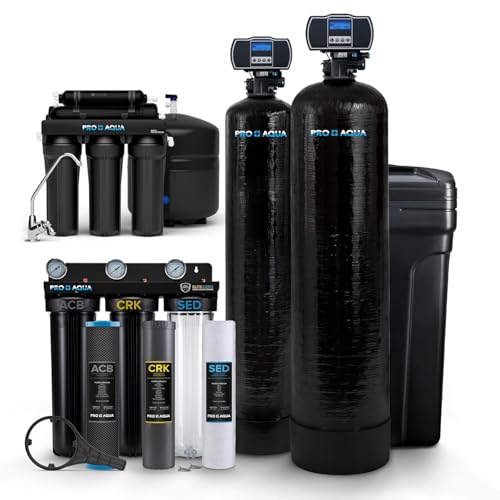
Best for: Small- to medium-sized households whose well water has several treatment needs, including hardness. PRO+AQUA describes this as a five-stage filtration and softener bundle intended for well water and homes with three to four bathrooms. Listed targets include heavy metals, iron, sulfur, sediment, and chlorine.
The staged design is intended to treat multiple water concerns in sequence, while the softener addresses hardness. The product listing also mentions an RO system in its name, so confirm the exact package contents and configuration before buying.
Limitation: A broad list of targeted contaminants does not establish that the system will solve a specific well-water problem. Match treatment to a current water test and verify flow and installation requirements for your household.
Aquasana Well Water Filter With UV

Best for: Well owners who want a multistage system that includes UV treatment and scale control. Listed stages include pre- and post-filters, carbon, KDF, UV, and salt-free Scale Control Media. Aquasana says the system reduces chlorine and addresses bacteria, viruses, and scale while preserving minerals.
The listing specifies a 500,000-gallon capacity or up to five years, and identifies a 5-year limited warranty. These details may help buyers compare expected service life, but actual maintenance needs should be checked against the product instructions and household water use.
Limitation: UV treatment is not a substitute for testing or for treatment of chemical contaminants. Confirm that the system’s listed treatment claims correspond to the specific contaminants found in your well.
iSpring WCFM500K Iron Filter

Best for: Well-water households whose testing identifies iron, manganese, or hydrogen sulfide. The manufacturer lists reduction of iron up to 12 ppm and manganese and hydrogen sulfide up to 20 ppm, as well as solids and turbidity with 3-micron sediment filtration.
Unlike cartridge-based systems, this model uses automatic media regeneration. Its digital control allows users to set automatic flush intervals based on water quality and usage. The listing says regeneration uses air rather than chemical oxidizers or chemical feeds, and that the media can last up to 10 years.
Limitation: This is a targeted treatment option, not a universal well-water filter. It does not list treatment for every concern, such as hardness or microorganisms, so additional treatment may be necessary depending on test results.
HQUA WF3-03 With UV
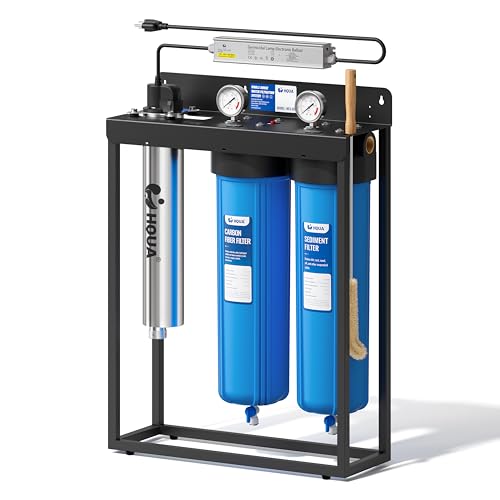
Best for: Buyers looking for a system that combines staged filtration with UV and listed PFAS reduction capability. The product features identify a 12 GPM, 55-watt UV unit and claim it reduces up to 99.99% of microorganisms. The listing also names PFOA and PFOS among the PFAS it is designed to reduce.
Its floor-standing or wall-mounted installation options may suit different utility-room layouts. Other listed targets include heavy metals, chlorine, sediment, odor, and VOCs.
Limitation: The supplied product details do not provide specific reduction percentages for PFAS or each chemical contaminant. UV addresses microorganisms, not dissolved metals or chemicals; check the product documentation and water test when evaluating those risks.
HQUA WF3-01 Three-Stage System

Best for: Buyers prioritizing sediment, chlorine, odor, and the heavy metals named in the product listing. Its three 20-by-5.5-inch cartridges include sediment and carbon filtration, plus a compound GAC+KDF filter. HQUA lists lead, mercury, arsenic, cadmium, and chromium among its reduction targets.
The unit can be bracket-mounted or used as a free-standing system, and the listed dimensions are 31 inches high, 23 inches wide, and 8 inches deep. The product description says no flow direction is required, which may simplify placement planning.
Limitation: Unlike the WF3-03, the supplied details do not list a UV stage. Do not choose it as a microorganism treatment system based on the listed features alone.
Buying Guide: How To Choose A Well Water Filter
What should I test before buying?
Start with a laboratory test of your well water. Test results can identify which contaminants or water-quality issues need attention. Consider testing for bacteria and other locally relevant concerns, and consult your local health department or a qualified water professional about testing guidance. Do not assume that odor, color, or taste reveals all potential problems.
Should I choose a whole-house filter or a targeted system?
A whole-house system treats water entering the home, while a targeted system may focus on one issue, such as iron or hydrogen sulfide. Choose a broad multistage system when test results show several concerns it is designed to address. A specialized filter can be a better fit when a particular contaminant is the main problem.
When does UV treatment matter?
UV is intended to address microorganisms, not sediment, metals, hardness, or chemical contaminants. Consider it when testing or professional guidance indicates a need for microorganism treatment. Follow the manufacturer’s requirements for installation and maintenance.
How do I compare capacity and maintenance?
Check rated flow, capacity, filter or media service needs, and installation dimensions. Cartridge systems require replacement filters; systems with automatic regeneration have different operating requirements. Confirm that the unit can serve the home’s expected demand and that replacement components are available.
Will a filter remove hardness or lower TDS?
Not necessarily. The PRO+AQUA listing describes a softener bundle, while the HQUA WF3-01 and WF3-03 details do not identify softening. The Ziwshom systems in the supplied product list state that they do not lower TDS. Verify the exact function of any system before purchase.
Frequently Asked Questions
Do all well-water homes need filtration?
No. The right treatment depends on test results, household needs, and local conditions. Test first, then select equipment designed for the identified issue.
Can one system remove every well-water contaminant?
No single system should be assumed to address every contaminant. Compare the product’s stated treatment targets with the laboratory report and consult a qualified professional when results are complex.
Does UV remove iron or arsenic?
No. UV is intended for microorganism treatment. Iron and arsenic require treatment specifically designed for those contaminants.
Can a whole-house filter replace drinking-water testing?
No. Filtration does not remove the need to test well water. Retest as recommended by local health authorities and follow the system’s maintenance instructions.