Best Wheelchair Ramps Over Stairs for Home Access
The right wheelchair ramp for stairs depends on the rise, available approach space, and whether you need a portable or more supportive setup. The VNN 4-, 5-, and 6-foot ramps suit different low-step heights; the TaiH Leo 8-foot model adds support legs for taller rises; and the FACHNUO 10-foot ramp is intended for higher steps. Measure the step height and check the ramp’s weight limit before choosing.
| Ramp | Best for | Listed rise range | Weight limit |
|---|---|---|---|
| VNN 4FT | Short rises | 4–12 inches | 800 lbs |
| VNN 5FT | Moderate rises | 5–15 inches | 800 lbs |
| VNN 6FT | Taller low-step access | 6–18 inches | 800 lbs |
| TaiH Leo 8FT | Higher steps and added mid-ramp support | 8–24 inches | 800 lbs |
| FACHNUO 10FT | Higher rises needing a longer ramp | 10–30 inches | 800 lbs |
VNN 4-Foot Ramp for Short Steps

Best for: Buyers who need a portable ramp for a rise between 4 and 12 inches and have limited space for a longer ramp. The listed weight capacity is 800 pounds.
The aluminum surface has raised folds and a non-skid coating for added traction. The ramp can also be fixed to a wooden platform with the included screws. These features make it a practical choice for a doorway, low step, or similar access point when the measured rise falls within the stated range.
Limitation: VNN notes that a long portable ramp can sink during use and rebound afterward. Confirm the rise and setup before use, and do not exceed the listed capacity.
VNN 5-Foot Ramp for Mid-Range Rises

Best for: Buyers whose step height is between 5 and 15 inches and who want a middle length between the 4- and 6-foot options. It has an 800-pound listed capacity.
The center hinge uses a seamless design intended to reduce the chance of a trip or difficult passage at the joint. Its folded aluminum surface and non-skid layer provide double traction features. The ramp can be secured to a wooden platform using the supplied screws, which may suit a more consistent home setup.
Limitation: This model is not intended for rises below 5 inches or above 15 inches according to the supplied product details. Measure the full vertical rise rather than choosing by appearance.
VNN 6-Foot Ramp for Taller Low Steps

Best for: Buyers who need to cover a 6- to 18-inch rise and can accommodate a 6-foot ramp. The listed weight capacity is 800 pounds, and the seamless center hinge is designed to make the transition across the joint less abrupt.
The ramp combines a folded aluminum surface with a non-skid layer. It can be fixed to a wooden platform with the included screws, which may help when the ramp is used at the same location. Choose this model over the shorter VNN options when the measured rise calls for its longer length.
Limitation: The stated range starts at 6 inches and ends at 18 inches. It is not the right choice if the rise or available landing space falls outside those limits.
TaiH Leo 8-Foot Ramp with Support Legs
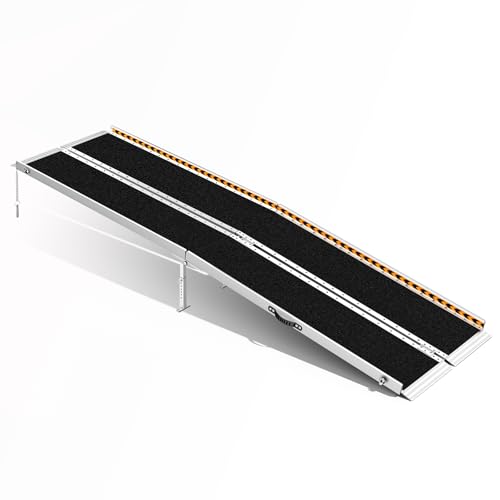
Best for: Buyers covering an 8- to 24-inch rise who want mid-point support. The ramp unfolds to 96 by 29 inches and has two adjustable support legs, listed as extending from 11 to 15.8 inches. Its capacity is 800 pounds.
The aluminum surface has a frosted layer and textured traction design. Side baffles and reflective warning stickers add visibility and help mark the edges. Transition plates at the top and bottom are designed to meet the ground more smoothly, and the product description says setup requires no tools.
Limitation: At 55 pounds, the ramp is heavy; the manufacturer recommends two people to lift it. Check whether you can safely move and store it before choosing it as a frequently relocated ramp.
FACHNUO 10-Foot Ramp for Higher Steps

Best for: Buyers with a 10- to 30-inch rise and enough room for a 10-foot ramp. The unfolded ramp measures 120 by 29 inches, folds to 60 by 14.5 by 6.3 inches, and has a listed 800-pound capacity.
Its side baffles and reflective strips are intended to improve edge visibility. Extended guide rails at both ends help the ramp meet the ground, while the pleated aluminum surface and non-slip layer provide traction. The product information recommends a ramp length at least four times the step height.
Limitation: This model weighs 71 pounds, and the manufacturer recommends that multiple people carry it. The long length also requires substantial clear space at the top and bottom.
Buying Guide: How to Choose a Wheelchair Ramp Over Stairs
How long should the ramp be?
Start with the vertical rise from the lower surface to the landing. Compare that measurement with the product’s stated range, then check whether the full ramp length fits without blocking a doorway or walkway. The FACHNUO product information recommends a length of at least four times the step height. This is a product-specific guideline, not a substitute for assessing the actual site and user needs.
Do support legs or rails matter?
Support legs can be useful when a longer ramp needs mid-point support; the TaiH Leo model lists two adjustable legs. Side baffles, guide rails, and reflective markings can help identify ramp edges. These details vary by model, so compare the features rather than assuming every portable ramp includes them.
What should you check before using the ramp?
- Confirm the rise, ramp length, and available space at both ends.
- Check the ramp’s listed capacity against the combined load of the user and mobility equipment.
- Use the ramp on a stable surface and follow the maker’s setup and securing instructions.
- Check whether the ramp’s weight and folded dimensions make it practical to move or store.
Frequently Asked Questions
Can a portable wheelchair ramp go over stairs?
It can provide a sloped path over a rise when the ramp is correctly sized and securely positioned. Check the product’s rise range, capacity, and setup instructions before use.
How do I measure the stairs for a ramp?
Measure the vertical distance from the lower surface to the top landing. Also measure the clear approach and landing space to ensure the ramp can fit.
Are longer wheelchair ramps easier to use?
A longer ramp creates a longer travel path and may be appropriate for a higher rise, but it also needs more room and can be heavier to handle. Choose based on the rise, site space, and product guidance.
What capacity should I look for?
Compare the listed capacity with the combined weight of the wheelchair user and equipment. Do not exceed the ramp’s stated limit.
Can I leave a portable ramp in place permanently?
Some listed models can be fixed to a wooden platform with included screws, but portable ramps differ in their installation details. Follow the manufacturer’s instructions and confirm the setup is suitable for the location.